Ten weeks, four markets. Chinese jewellery giant Chow Tai Fook has spent the past few months unveiling a new generation of luxury-format stores across some of the world’s most prestigious retail destinations. In January, Chow Tai Fook opened its key strategic store inside Bangkok luxury mall Siam Paragon. A month later, the brand introduced a 10,000sqft global flagship on Canton Road in Tsim Sha Tsui, standing alongside luxury giants like Hermès and Louis Vuitton. By late March, it was at Wes
Westfield Sydney, marking its first entry into Oceania. Vancouver, Canada, came soon after, with a location inside Oakridge Park.
“We revitalise key existing markets, while actively pursuing high-potential markets with strong long- term prospects,” Gabriela Ferreira, general manager of international business at Chow Tai Fook Group, told Inside Retail.
“We focus on markets with growing middle-class populations, strong tourism recovery, and a sizable community that appreciates Chinese culture, art and jewellery.”
These new markets, she said, ticked every box.
The jewellery group isn’t betting on Chinese tourists and diaspora alone, though. At Siam Paragon, Ferreira points to a well-balanced mix of local Thai customers alongside Chinese and international visitors.
“That balance is encouraging and reflects what we are building globally,” she said, adding that winning the local customer means designing for them.
Chow Tai Fook launched four-faced Buddha and golden elephant pieces in Thailand, kangaroo and koala charms in Australia, and a maple leaf collection for the Canadian debut.
“Each market gets something that is genuinely its own, not a replica of what we carry elsewhere,” Ferreira said.
She said consumers around the world are increasingly embracing Chinese aesthetics on their own terms rather than through Western interpretations, creating an opportunity for the brand to win market share internationally.
“Our retail sales value in other markets grew by 52.6 per cent in financial year 2026, a result that would not be possible without genuine demand from diverse customer segments.”
The pipeline is mapped with further newly designed stores across Southeast Asia and North America in FY27. Plans for the Middle East entry are also under way.
Store makeover
While expanding its footprint internationally, the brand is also rolling out new luxury-format stores, which have driven a clear uplift in sales after conversion.
Ferreira’s summary is that the brand transformation is doing the work. The store design draws customers in, the product mix shifts meaningfully toward design-led jewellery that tells a culturally resonant story, and the service model creates space for genuine engagement.
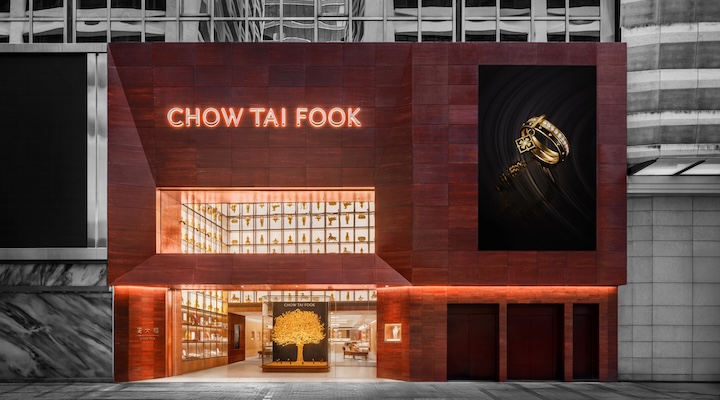
The Canton Road flagship is the fullest expression of Chow Tai Fook’s new look. It houses a Heritage Pavilion chronicling the brand’s history, a homeware line dubbed Chow Tai Fook Home created with venerable French porcelain maison Bernardaud, a high jewellery and Hearts On Fire offer, a bridal zone, and a private VIP salon.
The floor is zoned by collection – Rouge, Joie, Palace Museum, Huá – and anchored by ‘Charm Your Path’, an interactive personalisation experience making its Hong Kong debut. The store has generated close to HK$60 million (US$7.7 million) in retail sales value a month since opening in February.
The company stated that the newly designed luxury-format stores in Mainland China are generating productivity roughly eight to 10 times the average across the broader store network, and renovated stores have shown a 15 per cent productivity uplift.
“We plan to expand our network of newly designed luxury-format stores in Mainland China from eight today to 50 by financial year 2030,” Ferreira said.
Faces and fortunes
Earlier this year, Chow Tai Fook named actor Yang Yang global brand ambassador; he fronted a Lunar New Year campaign built on blessings passing between generations. In July, the group appointed actress Zhao Lusi to the role of global brand ambassador, further reinforcing its push to connect with younger consumers across Asia.
For the under-35 luxury customer, Ferreira said, “the starting point for any collection is no longer just the object itself – it is the meaning it carries and the story it tells.”
The Rouge collection, conceived for Chow Tai Fook’s 95th anniversary, was built around the Chinese concept of blessings and fortune, with “the architectural motif of Chinese windowsills, which symbolise the passing of blessings between generations,” as its creative anchor.
The commercial weight is considerable. The Huá Collection contributed HK$43 billion (US$5.5 billion) to retail sales value in FY26; Rouge, Joie and the Palace Museum line together added close to HK$10 billion (US$1.3 billion).
The newest launch, Dawn, was designed for younger customers who wear jewellery as self-expression, and cleared HK$500 million (US$63.8 million) slightly over a month after launch, with more than 20 per cent of buyers entirely new to the brand.
“What we look for next is a gap in the market that only we can fill,” Ferreira said.
Meanwhile, IP collaborations do the customer acquisition. The tie-up with “Black Myth: Wukong,” China’s first AAA video game, grew more than 130 per cent, year on year, in retail sales value after its second drop. It also drew a customer base more than 30 per cent male.
“People often forget about male consumers, because female customers are such a dominant force in the jewellery industry,” Ferreira said. “Nevertheless, we are seeing meaningful signals that male consumers, particularly younger ones, are open to jewellery as self-expression – if the design language speaks to them and the cultural reference resonates.”
A Disney blind-box collection and a Chiikawa collaboration that prompted queues at select stores skewed heavily toward younger, first-time members. Across the IP program, roughly 35 to 55 per cent of customers were new loyalty members.
“That tells us the appetite is there, and we should create the right product portfolio to meet customers where they already are,” Ferreira said.
She added that jewellery is escaping the jewellery box.
“It is becoming part of how people live, in their homes, their daily routines, and their sense of identity.”
Drawing the map to 2030
Ferreira expects growth to come from both new markets and deeper penetration of existing ones. Meanwhile, the company has planned for an accelerated e-commerce push to build digital share in Singapore, Japan, South Korea and North America.
“The goal is to double the retail sales value of our international operations by financial year 2030, compared with financial year 2026, and to reach more than 100 stores outside of our home market,” she added.
However, it is all playing out against the most turbulent gold market in years. The World Gold Council stated that Chinese gold jewellery demand fell 32 per cent, year on year, in the first quarter of this year. In contrast, Chinese bar and coin demand hit a record 207 tonnes in Q1, up 67 per cent.
That divergence has created a clear divide within the industry. Jewellers whose businesses depend largely on selling gold by weight have faced weaker consumer demand as prices have climbed. Brands with stronger design credentials and fixed-price collections have been better insulated, however, allowing them to preserve margins while encouraging customers to buy for craftsmanship and design rather than bullion value alone.
Chow Tai Fook’s design-led signature collections reached about 29 per cent of group revenue in FY25, up from 19 per cent a year earlier.
Ferreira said the company is finding a genuine growing interest in Chinese culture, design and craftsmanship, particularly among younger audiences who are rethinking what heritage and luxury mean to them.
Chow Tai Fook unveiled its first high jewellery collection, dubbed ‘Timeless Harmony’, last year, followed by the ‘Chinese Couture’ collection launched in June.
“Chow Tai Fook has interpreted Eastern aesthetics through contemporary design for nearly a century,” Ferreira explained. “Each piece is crafted by our in-house studio, drawing on master artisans who bring together traditional and innovative high-jewellery techniques developed over decades. It not only directly engages the most discerning collectors but also elevates our brand desirability and positioning across the entire portfolio.”
The financial results suggest the strategy is gaining traction. Revenue rose 5.3 per cent, to HK$94.4 billion, in FY26, operating profit lifted 27.8 per cent, to HK$18.9 billion, and profit attributable to shareholders went up 52.2 per cent, to a record HK$9 billion.
High-jewellery clientele, Ferreira noted, have “remained largely unaffected by the macroeconomic pressures that have weighed on broader consumer sentiment.” The momentum has carried into the new financial year, with same-store sales between April and June up 20 per cent on the mainland and 41 per cent in Hong Kong and Macau.
However, the market disruption remains visible.
“The direction of our transformation was already clearly set before these pressures intensified,” Ferreira said.
With almost a century of navigating economic cycles, changing consumer tastes and a rapidly evolving luxury landscape, Ferreira sees the group’s centenary in 2029 as the beginning of its next chapter.
“We see that milestone not as a moment to look back, but as a platform to demonstrate to the world what Chinese luxury can be at its finest.”
This story first appeared in the August 2026 issue of Inside Retail Asia magazine.