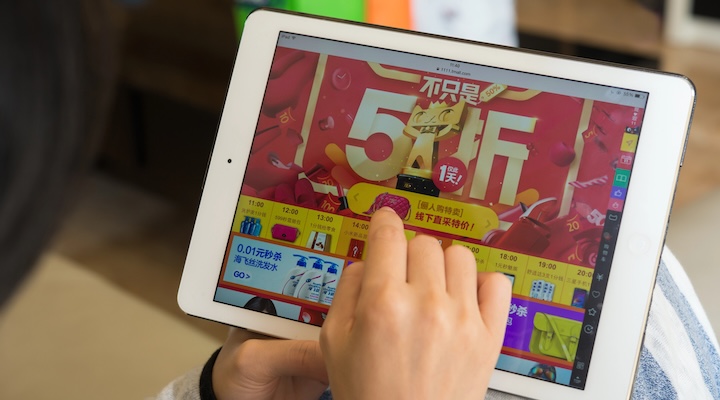
Taobao and Tmall have started the Double 11 shopping event and customers noticed. The cross-store vouchers that once sent people padding their baskets to reach “spend RMB300, save RMB50” are gone from Alibaba’s headline mechanics. In their place is an “official instant discount” taken off each item at checkout, with no threshold to hit. Alibaba is using the festival it created in 2009 to test whether cleaner prices, AI-led shopping and a tighter grip on its highest-spending membe
members can restart a marketplace that barely grew in its most recent quarter.
Outside China, the same app is being sold in a different way. Taobao launched Double 11 simultaneously in 20 overseas markets, fronted by actor Zhang Linghe, with a pitch built on distinctive Chinese brands rather than low prices.
The event is still enormous. Beijing-based data firm Syntun estimates that Double 11 sales across Chinese online platforms reached RMB1.695 trillion (about US$238 billion at the time) last year, up 14.2 per cent, over a window running from 7 October to 11 November.
“It’s the largest shopping festival in the world,” said Jacob Cooke, co-founder and CEO of WPIC Marketing + Technologies, which helps international brands sell on Chinese and Asian marketplaces.
Tmall opened presales on 15 October and runs in-stock sales until 13 November. It says a record 1 million brands and 72 million products are taking part, including 60,000 merchants joining Double 11 for the first time.
A price shoppers can read
The retreat from threshold coupons has been under way for more than a year. Taobao and Tmall dropped cross-store discounts for the last 618 festival and last year’s Double 11 ran on a flat 15 per cent instant discount.
“With government subsidies also still in place (and visible on the platforms directly), consumers will be able to see a clear lower price for every product they’re viewing, which should drive purchases,” Cooke said. China’s trade-in program now offers a flat 15 per cent subsidy across 10 categories and Taobao displays it alongside platform discounts.
The bigger payoff may come after the order is placed.
“This change is also a win for merchants because in previous editions of the festival, customers would over-buy to hit the discount threshold, and then return products they didn’t want,” Cooke said. “And it’s also a win for consumers, who generally prefer simplified discounting.”
AI movies to the checkout
Earlier this year, Alibaba connected its Qwen app directly to Taobao, letting users choose, compare and pay for goods inside a chat, while a Qwen shopping assistant within the Taobao app offers virtual try-ons and works out which discounts apply.
This is the first Double 11 in which a shopper can complete the whole purchase through an assistant.
Cooke expects that to matter across the sector.
“[I’m] expecting AI shopping assistants to play an important role in the festival, with the chatbots Qwen (Alibaba), Dongdong (JD) and Doubao (Douyin) now fully integrated into the shopping experience on their respective platforms,” he said. “Our client teams are helping position brands to appear in these AI-generated results.”
Automation is also reaching content. “We’re also seeing significantly more AI-generated livestreams than last year,” Cooke said, adding that WPIC has run its own for about two years.
Taobao abroad: From cheap to distinctive
The company is now looking to deepen its influence beyond China. More than 1.2 million Taobao and Tmall merchants are selling cross-border this Double 11. Taobao says demand for Chinese goods abroad is moving from price towards quality, with the number of shoppers spending more than RMB500 per order growing 10 per cent year on year during last year’s festival, and many international travellers now using the app while in China to have purchases delivered to their hotels.
To serve that shift, Taobao has built what it calls a Curated Supply System, which combines AI with human selection against four criteria – quality, distinctiveness, price competitiveness and service. It has picked out 4000 original-brand stores and 6 million products from a cross-border catalogue of more than 3 billion.
The logistics promises are as important as the curation. Taobao is offering tiered one-, three- and six-day delivery commitments depending on the market, flat-rate shipping for bulky items in 10 markets, free shipping for large furniture in Singapore, compensation for lost or damaged parcels and local returns in 13 markets.
Zhang Linghe, whose following is strongest in markets such as Thailand and Malaysia, fronts a campaign with billboards, themed trains and glasses-free 3D displays in Hong Kong, Kuala Lumpur, Bangkok and Singapore, a daily in-app treasure hunt in five markets and a livestream across 11 markets during Double 11.
“Every critical touchpoint in the cross-border shopping journey has been refreshed,” said Ye Tian, general manager of Taobao Tmall World.
Members and rivals
At home, Alibaba is leaning on its best customers. The 88VIP membership, which spans Taobao and Tmall, had about 64 million members at the end of June and was still growing at double digits, the company said.
“[88VIP] has been massively successful at creating value for premium shoppers, and also to better monetise those users for the platform,” Cooke said.
Rivals are not waiting. JD.com opened its campaign on 12 October and dropped deposit-based presales, while Douyin is applying an official 15 per cent cut and handing out coupons through ByteDance apps including the Doubao chatbot.
Cooke said Douyin and RedNote are giving out more platform vouchers per traffic than previous years, and that RedNote is using the festival to sign shoppers up to a new e-commerce membership, the Little Red Card.
“It will be interesting if RedNote can replicate,” he said.

![A headshot image of Hannah Mercer wearing a purple hoodie against a gray background. ]\\](https://insideretail.co.nz/wp-content/uploads/2025/10/hannah-mercer-gymshark-530x294.jpg)