
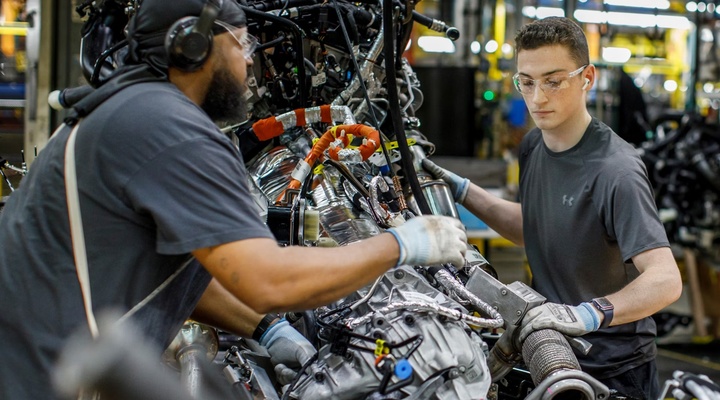
Ford just gave us the most expensive case study in recent history as to why AI should work alongside employees, rather than replace them. The automaker last month hit No. 1 in the JD Power Initial Quality Study for the first time in 16 years. Not by deploying more AI. By hiring back the humans they let go. Now, although that’s been the headline everyone is running with – AI failed, humans saved the day, roll credits – the real story is more uncomfortable than that, and it has almost nothin
nothing to do with technology.
What actually happened
Ford cut roughly 5,300 salaried positions from its peak in 2020, and the logic made sense on paper. AI-driven quality systems could ingest design requirements, flag defect patterns, and catch failures faster than any human team. Automated inspection cameras were rolled out across 33 plants worldwide, more than 1,000 of them, running millions of checks.
The assumption was pretty straightforward. Feed the system enough data about what good looks like, and it will learn to enforce quality at scale. So they let the experienced engineers walk.
By mid-2024, recalls were costing Ford $4.8 billion a year, and the company had issued the most recalls ever by a single automaker in one year. The bottom line was that AI wasn’t catching what the humans used to catch, and now the humans were gone.
Charles Poon, Ford’s VP of vehicle hardware engineering, said it plainly, “Mistakenly, we thought that by just introducing artificial intelligence and ingesting the design requirements that we had, that that would produce a high-quality product.”
The fix wasn’t more AI. It was more humans.
Over three years, Ford hired back around 350 veteran engineers. Many were former employees. Some came from suppliers, but internally they are known as the “grey beards”. Their job wasn’t to replace the AI – it was to fix it, train it properly, and mentor younger engineers.
COO Kumar Galhotra said these engineers were “at the heart” of the turnaround. They now run mandatory weekly design reviews, and they hunt for failure points before a part ever reaches the factory floor. For the 2026 Expedition alone, Ford added 1,200 new inspections and 203 new human inspectors at the Kentucky Truck Plant.
The result: Ford went from No. 16 among mainstream brands in the 2023 JD Power study to No. 1 in 2026. A score of 152 problems per 100 vehicles, ahead of Nissan and Buick. Seven of the company’s 10 tested models finished in the top three of their segments. CEO Jim Farley called it working “really hard for four years to be an overnight success story”.
The AI cameras are still running, and the automated systems are still in place, but they now work because experienced people are telling them what to look for.
This is not an AI story. This is a knowledge story
Ford didn’t have a technology failure – it had a knowledge architecture failure. The company assumed expertise was just data and something you could extract from experienced engineers, feed into a model, and replicate without the people who created it.
But expertise isn’t data. It’s pattern recognition built over decades of contextual judgment, and it’s the ability to look at a spec and feel that something is wrong before you can articulate why. It’s knowing which tolerances matter in which combinations under which conditions because you’ve seen what happens when they don’t hold. None of that transfers into a training dataset – it transfers through relationships, mentorship, and time spent working alongside someone who’s been through it before.
The moment Ford let those people leave, the AI had nothing good to learn from. It was trained on whatever remained, and what remained produced what one writer called “automated mediocrity at scale”.
Ford is not alone in this
Forrester’s 2026 Future of Work report found that 55 per cent of employers are now regretting laying off workers due to AI. It predicts that over half of AI-attributed layoffs will be quietly reversed, and it speculates that as many as 73 per cent of organisations that executed AI-driven staff cuts failed to come out financially ahead, driven by escalating technical costs and premium rehiring expenses.
Gartner surveyed 350 global executives at companies with over $1 billion in revenue and found that roughly 80 per cent of organisations deploying AI reported workforce reductions. Still, those cuts showed no meaningful correlation with improved return on investment. The companies getting stronger results were the ones using AI to help people work better, not those using it to replace people entirely.
Across Detroit’s three big automakers alone, more than 20,000 white-collar jobs have been removed this decade. Ford CEO Jim Farley himself said at the 2024 Aspen Ideas Festival that AI would replace half of all white-collar workers in the US. Less than two years on, his own company’s turnaround story is built on hiring them back.
What this means for every brand, not just automakers
The same pattern is playing out across retail, fashion, customer experience, and creative right now. Brands are feeding AI tools the surface-level outputs of their best people without understanding the judgment that shaped those outputs in the first place, and they’re getting back something that looks right but feels hollow.
An AI can generate brand copy that sounds like your brand, analyse customer data and produce segments, build product recommendations, and automate service responses. Still, it can’t tell you why your best store manager greets a returning customer differently on a Tuesday morning than on a Saturday afternoon. It can’t feel the shift in a collection that’s about to lose its edge. It can’t read a room during a pitch or sell in and adjust the entire strategy in real time based on something that was never said out loud.
Those things live in people, and they always have. So when those people leave, and nobody captures what they carry, the system doesn’t just lose a function – it loses the ability to know what good looks like.
Ford spent $4.8 billion a year learning that lesson the hard way. Poon said it himself: “We didn’t pay as much attention as we should have to the experience of our most knowledgeable engineers who have been with us through many product cycles.”
AI is an amplifier. That’s it – the end.
This isn’t about choosing sides. Brands shouldn’t abandon AI or their people. We have to stop pretending the two are interchangeable.
AI amplifies whatever you feed it. Feed it the accumulated judgment of your best people, and you get scale. Feed it the absence of that judgment, and you get scale too. Just scale in the wrong direction.
We need to stop thinking, “How do we use AI to do more with fewer people?” We need to be thinking, “Have we actually captured what makes our best people good, and are we sure the system is learning from that, or is it learning from whatever’s left?”
Ford answered that question the hard way. The company got it wrong. It cost billions. And it fixed the problem by putting humans back at the centre and using AI as the support tool it was always supposed to be.
If brands can learn from Ford’s mistake without repeating it, they will have a real advantage. Those still chasing headcount reduction as a strategy are simply building their own version of automated mediocrity.
And unlike Ford, most of them won’t have a $4.8 billion wake-up call to force the correction.
Nick Gray is the Founder and CEO of IGU Global, a Sydney-based retail and brand strategy consultancy.
Further reading: What is Nike really selling with its Virgil Abloh drop?




![A headshot image of Hannah Mercer wearing a purple hoodie against a gray background. ]\\](https://insideretail.co.nz/wp-content/uploads/2025/10/hannah-mercer-gymshark-530x294.jpg)
