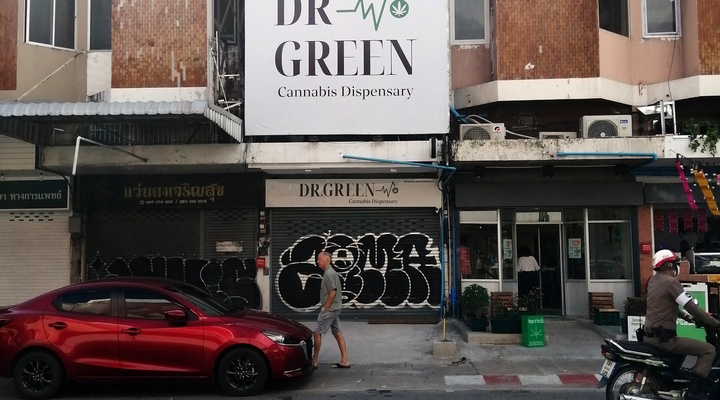
You see them everywhere in Thailand: some occupying prominent street-corner spaces; others little hole-in-the-wall dispensaries. These shops are easy to identify because of their green livery and marijuana plant logos, but a staggering number of them – more than 10,000 – are no longer trading, and thousands more will follow in their footsteps over the next year. This is the mess left behind by opportunists who badly misread the tea leaves when former health minister, now prime minister, Anut
in Charnvirakul, decriminalised possession of cannabis in 2022. Exactly one year ago, the decriminalisation was reversed with the prime minister’s support, crushing the industry.
Fortunately, some of the shops are already reoccupied by other businesses, but many are awaiting re-tenanting or demolition. Others continue trading quietly under the radar, awaiting the expiration of their licences, which will trigger a full review of their legal compliance and, in the overwhelming majority of cases, result in their closure. Meanwhile, the authorities are continuing to investigate businesses suspected of trading on the edge of the law.
The ex-pot shops stand as glaring testaments to how a flourishing retail segment got way ahead of itself, failed to grasp the ease with which deregulation could be reversed, annoyed a large swathe of the population with rampant exhibitionism, and has subsequently been decimated by the stroke of a government pen.
If you don’t convert to a bona fide medical clinic, you’re done.
Sales are now restricted to customers for health purposes only, and, as with any prescription drug sold by a pharmacy, a prescription from a licensed medical professional is required. In essence, you now have to be a clinic or a pharmacy to operate one of these establishments. When the re-regulation came into force last June, there were, according to most accounts, around 18,000 dispensaries operating in the kingdom. By the end of the year, only about 1,300 of the more than 8,500 licences that came up for renewal had been reactivated. The other 7,000+ were unviable and shut down. It isn’t clear how many more have had to close in 2026, but the licences expire on a rolling basis, and the likeliest scenario is that, when the dust settles, there will be no more than a few thousand left that meet the new requirements.
It is hard to put a finger on exactly how many of the ‘closed’ establishments are still doing illicit business. Although the Ministry of Health is keen to advertise that it is being proactive in ensuring operating businesses comply with the law, this is Thailand, where there is never a shortage of individuals willing to explore loopholes in the law. One restaurant owner I spoke with in a large provincial capital told me the smell of weed emanating from the cannabis shop next door was so bad it was disturbing his customers. He was asking smokers to cross the street if they wouldn’t mind.
Some shops have survived by hiring a doctor to provide in-store prescriptions, but the economics do not work for most dispensaries. With the heavy fines and jail time that can be incurred through non-compliance, most simply shut their doors once their licence expires, or even before. This, of course, leads to a problem of vacant real estate, which is both an economic issue for landlords and an aesthetic issue for the neighbourhood.
What’s happening with all the vacant real estate?
When thousands of shops suddenly become unviable, it affects the local real estate market. In highly trafficked tourist areas such as Sukhumvit in Bangkok, Pattaya and Phuket, vacancies are quickly reoccupied by other businesses, particularly tourism-oriented ones such as restaurants, massage shops and bars. In less-trafficked locations, it is more of a problem: the stickiness of vacancy is high, and the neglected shopfronts, once cheerful but now fading Sherwood Forest green, have become an eyesore.
Tourism has also been affected.
It is also possible that the softness in international tourist arrivals in the back half of 2025 and continuing into this year is partly due to the crackdown on the sale of cannabis for recreational use. Cannabis had become a tourist attraction for many, and this also annoyed many locals and tourists who were unhappy about the pot-smoking culture, which included lighting up in restaurants, on beaches and in other public places. However, the good news is that family-oriented tourists may now be returning in greater numbers.
Alcohol trading hours are another regulatory target
On multiple occasions recently, Thai regulators have tinkered with liquor laws. First, they experimented with extending liquor retail sales from noon to midnight, temporarily lifting the notorious ban on sales between 2pm and 5pm that had been in place since the early 1970s. It was only a six-month trial, but now that it is over and deemed a success, the extended afternoon sales hours have been made permanent.
The likely reason for trialling it in the first instance, or at least part of the reason, was to see whether liberalised trading hours would make the nation’s notoriously dangerous roads even less safe than they already were. Having decided that the coast was clear on road safety, the regulators asked themselves: why not push back the daily start time of liquor sales from noon to 11am? Sure, why not? (Which begs the question of why such arbitrary trading-hour limits exist at all.) Retailers can now sell alcohol from 11am to midnight.
Who knows what the next regulatory change will be? It is doubtful we will have to wait long to find out. After all, the business model of a regulator is to regulate, because if they don’t, then many regulators would be out of a job. In Thailand, regulators have grasped this reality perfectly and remain just as hyperactive as anywhere else.