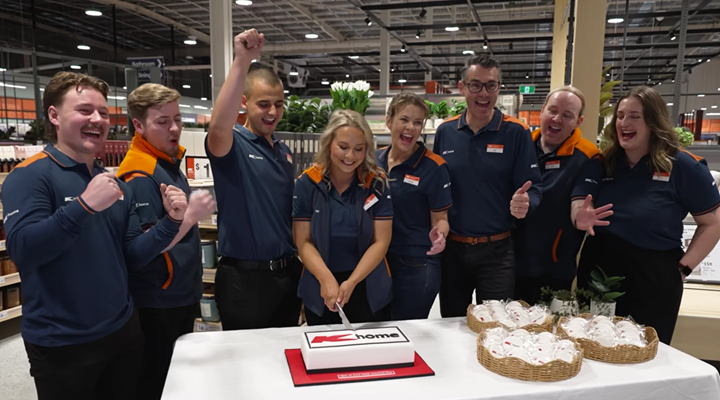
Kmart has spent years transforming Anko into one of Australia’s most formidable private-label success stories. This week, the Wesfarmers-owned retailer took its next step with the opening of K Home in Australia, a 3000 square-meter concept store in Melbourne’s Box Hill South dedicated almost entirely to furniture, storage and homewares. The format brings together products that have traditionally lived online, although now in expansive room settings and immersive displays. The opening marks o
ne of Kmart’s most ambitious category plays in years, yet while much of the attention has centred on competition with Ikea, the more consequential question may be whether the concept can be replicated beyond a single postcode.
A retail opportunity wrapped in a property question
Australia’s homewares sector has spent much of the year grappling with disruption following the collapse of several established retailers. Barbeques Galore entered voluntary administration in February, following its acquisition by US investment firm Gordon Brothers in late 2025. Lincraft soon followed, entering administration and announcing the closure of dozens of stores across Australia. Those developments have welcomed speculation that Kmart may inherit a growing pool of vacant retail space if K Home proves successful. Yet the proposition is more intricate than a game of retail musical chairs, as property availability, planning requirements, regulations and site suitability may ultimately determine the concept’s trajectory.
K Home is the culmination of years of growth in a category that has become progressively important to the business. Wesfarmers reached almost $46 billion in sales last financial year, while Kmart contributed $11.4 billion and now accounts for an estimated 10 to 12 per cent of Australia’s $35 billion furniture and homewares market. General manager of store experience, Courtny Keeble, told Inside Retail the concept emerged in response to customer demand. “We often get feedback in-store that customers want to touch and feel products and see what it looks like outside the box,” she said. “When we look at how furniture stores in particular run, they have samples and displays, and that’s what we’ve done, to bring together our whole range and help inspire our customers to create the homes they love.”
The realities of expansion
The enthusiasm surrounding K Home has inevitably prompted questions about where more stores could be located. Retail consultant Dean Salakas believes assumptions about vacant retail space deserve closer scrutiny. “K Home is around a 3,000sqm+ format, whereas many Barbeques Galore and Lincraft stores are closer to around the 800sqm mark, so I don’t think it’s as simple as K Home just moving into those vacant stores,” he told Inside Retail. Some larger flagship sites may be suitable, while others could require landlords to combine adjoining tenancies. “K Home needs the right sites, not just any sites,” he added.
Finding a suitably sized tenancy is only part of the equation, as planning regulations can also influence where K Home can operate. Speaking at Wesfarmers’ recent strategy briefing, CEO Rob Scott noted that some jurisdictions restrict the sale of bulky goods, such as furniture, alongside general merchandise. “We’ve been developing the furniture category for a number of years now, but we’ve only been selling it online because there are limitations for us to effectively display the furniture within a Kmart shop,” he said.
To add to that, property data suggests those challenges are considerably relevant. Colliers’ Population Growth Report projects an undersupply of 2.2 million square metres of retail floorspace by 2032, creating conditions that could see an additional $20.5 billion in retail sales move through existing centres as population growth outpaces development.
While suitable sites may prove elusive, the overall consumer environment seems favourable. Households are scrutinising discretionary purchases with greater discipline than ever due to prolonged cost-of-living pressures. Salakas believes that trend is playing directly into Kmart’s hands. “Customers are increasingly trading down and looking for value, which plays directly into Kmart’s strength and this new format,” he said. Scott also observed that shoppers are gravitating towards entry-level price points.
The experiment begins after opening day
Kmart itself appears acutely aware that K Home remains an experiment. Managing director Aleks Spaseska has previously suggested there may be scope for as many as 50 K Home stores across Australia and New Zealand, contingent on the success of the Melbourne trial. For now, the retailer is focused on gathering evidence. General manager of property Ben Smith has described the concept as a fact-finding mission, explaining that management intends to get a good read on customer reaction. The Box Hill South store serves a catchment of more than 100,000 residents, but even so, Smith acknowledges one crucial unknown. “We just don’t know quite how far people will travel for this store,” he admitted. The answer may determine whether K Home becomes Australia’s next major retail format or remains a fascinating one-store experiment.