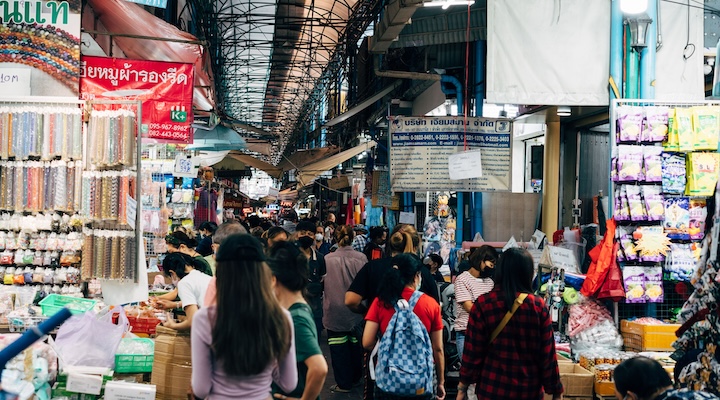
In Thailand, flea markets are growing in stature and popularity as a shopping format, and perhaps it would be appropriate if the international peak body for shopping centres, ICSC, included them in its taxonomy of Asian shopping places. Sure, many of them can be grubby, hot and uncomfortable, but that is part of the charm. Some of the lesser markets house merchandise that is poorly designed and manufactured, and they can be brimming with counterfeits, but the good ones compensate for the bad one
ones by being indispensable incubators for local designers and craftspeople, offering unique merchandise across a vast range of retail categories, bursting with vintage fashion and, well, having everything that is special that you can’t find in one of the country’s splendid air-conditioned malls. And, as if that’s not enough, they are social hubs in hundreds of communities.
Many Thais have come to the same conclusion that Americans came to about their suburban malls 20 years ago: They have become too monotonous because they house the same brands that you can see anywhere on the globe. The flea market offers a treasure hunt for the unique, and an opportunity to pull buyer and seller into a warmer and more meaningful interaction than in the deeply transactional mall setting. For millions across Thailand, they have become the places to see and be seen. They are being given a boost by the growing interest in vintage and secondhand fashion for which Thais seem to have an inexhaustible thirst.
This doesn’t mean malls are being displaced, by any means, but it emphasises that they serve a complementary purpose: If you want comfort, the assurance provided by established national and global brands, the mall is where you come, but if you want that special, hard-to-find or uniquely crafted item, the flea market is the first choice.
The commercial lifeblood of a nation
Thailand has thousands of these markets, and there is one operating in just about every single town in the country with a population of about 20,000 or more. Indeed, the local markets date back to about 1940, when the then-prime minister ordained that every town should have one so that the locals had a common platform for selling their goods. One of the earliest of these markets established after the prime minister’s edict was the Chatuchak Weekend Market in Bangkok, which has become justly world-famous because of its massive size, endless variety, and treasure trove of merchandise that you can’t find anywhere else.
Many of Thailand’s markets open on only one or a few days a week, or only at night time. In the smaller towns, they attract local vendors selling clothes, all kinds of accessories, handicrafts, cookware and food, and many are selling goods that were produced locally. These are scrappy, but highly social affairs that take the place of the malls, which can be located only in cities where the population is big enough to support one. The quality of the merchandise can be iffy but this doesn’t bother anyone: Many of the visitors are out with their friends after school. They would be young mall rats if there were a mall but they make do with the flea market because it’s all there is. Other visitors come from surrounding villages, drawn to the market because it is their big social event for the week. These flea markets are absolutely essential commercial and community hubs.
Bangkok is where the action is
Naturally, it is the markets in the cities that get the attention, because they are proving grounds for labels that, if they are good enough, achieve national or international recognition as visitors, bloggers and influencers spread the word. Some make their way into other retail formats. The malls themselves have to some extent become conduits for this process via their pop-up precincts, like those at Emsphere in Bangkok.
Although hundreds of flea markets around the country have their own specialties, cache, and devotees, Bangkok is the place where much of the action is when it comes to brands that want to make the leap to stardom. And most of that action is at Chatuchak, which bills itself as the world’s largest, with more than 15,000 stalls that attract an average of 200,000 visitors every weekend.
Rental costs vary widely, depending on location within the market and the size of the stall. It can cost as little as US$20 a month to rent a 1sqm stall, up to more than US$1800 for a large space near major walkways and other traffic chokepoints. Brokers for Chatuchak store rentals are currently listing stalls in moderately trafficked locations at monthly rates in the range of $20 to $40 per square metre.
Brands with their roots in Chatuchak
Chatuchak is a place with enough critical mass, foot traffic and fame to make it an alternative launch pad for fashion and other brands that may have larger ambitions. Since most brands launch in a number of different low-rent environments – flea markets, online marketplaces, mall pop-ups, suburban strips are all possibilities – it is rare to find successful brands that have their roots exclusively in flea markets that graduated to malls and other high-profile street locations, but they do exist. Examples include Ta.Tha.Ta (designer bags), which has a stall in the Chatuchak Market but also has a presence in Bangkok’s premier upscale shopping malls, such as Siam Paragon, Icon Siam and Siam Center. The Sleeveless Garden is a designer leather goods brand that appears in both Siam Discovery and Emsphere malls. Many, however, achieve national and even international prominence without ever leaving the market. Chatuchak is the most fertile proving ground for this in Thailand, with examples like Matin Calme, a handmade silver jewelry brand, streetwear brand Common-T, Hyena for tie-dyed clothes and dresses, and a host of others across every major retail category.
Challengers to Chatuchak include the famous Pratunam Market, which is downtown, the Pattavikorn Market in northeastern Bangkok, famous for its secondhand goods, and the six-level air- conditioned Bangsue Junction that operates cheek-by-jowl with Chatuchak.
Local specialties
Not all of Thailand’s amazing flea markets are in Bangkok, and local markets offer local specialties. For example, Chiang Mai’s night markets, including its night bazaar, are platforms for the unique handcrafted clothing and accessories of the Thai hill tribes, including the Hmong people. And there are flea markets in highly unusual settings. About 140 kilometres south of Bangkok in Chonburi Province is Coffee War, which at first sight looks like nothing more than a surreal parking lot for disused airliners. Sitting there are three decommissioned wide-bodied aircraft that were formerly the property of Thai Airways, along with a Cambodian Lockheed L1011. One of them, an A-330 Airbus, has been reconfigured as a cafe. While the aircraft capture the initial attention, they conceal the fact that Coffee War is also a flea market. The four bigger planes are accompanied by small aircraft, helicopters, military jeeps, and shops selling military apparel and war memorabilia. The market was set up by a retired Thai military officer and has an extraordinary offering of clothes, bags, accessories and eye-popping battlefield antiques like manual typewriters, weapons, military cooking appliances and camping gear. Many items don’t have a fixed price and at one shop, price has to be negotiated with the vendor. For collectors of vintage war paraphernalia, it’s paradise.
It’s time for a change of name
Flea markets have a bad name. Not in the sense of reputation though, quite the opposite. It’s that the name itself has never really been updated to do justice to how good so many of them are, or even to reflect their true purpose. The name ‘flea market’ is thought to have originated in the 19th century in France, where a particular market sold secondhand goods that were suspected of being flea- infested. The term stuck, and hasn’t really been changed. Yet these markets have a proper place in the pantheon of Asian retail formats, and it is time that the name was updated to reflect the reality. If neighbourhood and community shopping centres, super-regional malls, megamalls, hypermarkets, supermarkets and department stores can have decent names that reflect their form and function, then why not flea markets? Retail marketers, who are so good at putting old wine in new bottles, should sharpen their pencils.
This story first appeared in the May 2026 issue of Inside Retail Asia magazine.

![A headshot image of Hannah Mercer wearing a purple hoodie against a gray background. ]\\](https://insideretail.co.nz/wp-content/uploads/2025/10/hannah-mercer-gymshark-530x294.jpg)