John K almost didn’t book the trip. Airfare from Singapore had crept up again, and three days in Ho Chi Minh City felt harder to justify on a tight long weekend. He booked it anyway. Instead of spending time at museums and touristy spots, he moved between fashion retailers and complexes in the heart of the city, looking for the kind of clothes he’d pay serious money for back home but couldn’t quite find. He had followed a recommendation down Dong Khoi Street, ducked into Union
on Square to escape the midday heat, and found himself descending to the lower floor of Rue Miche L’Édition without quite meaning to.
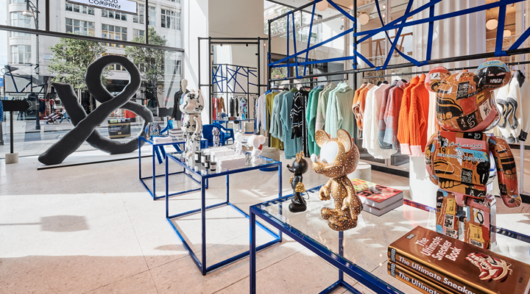
An art installation anchored in the heart of the space. Each brand had its own corner, but the borders between them were porous, the whole floor flowed. He bought two pieces from Vietnamese label Victim of the Prime on that first visit. He came back to Rue Miche’s other branch the next day for a third.
“The designs and quality are unmatched,” he said. “And they’re so much more affordable than anything comparable in Singapore.”
John K is not alone. In recent years, the city has seen a wave of tourists from nearby countries and even from further afield visiting specifically for shopping. Social media is swamped with TikTok haul videos, travel forums are full of District 1 retail itineraries, and fashion- conscious travelers are building trips around Ho Chi Minh City the way an earlier generation built theirs around Bangkok’s weekend markets or Seoul’s Hongdae district.
At the center of that shift, more than any single brand or street, sits Rue Miche.
The beginning of a story
Founded in 2023 by Hoang Manh Tuong, Aiden Truong and Christina Vu, Rue Miche began as a platform for emerging Vietnamese designers with strong identity and product and lack of infrastructure to properly present.
“The earliest version was just a curated multi-brand space,” Vu told Inside Retail. “But over time, it evolved into a cohesive ecosystem where brands not just co-exist but interact and complement each other.”
The first location was opened on Phung Khac Khoan street and has a smaller yet more intimate counterpoint compared to the flagship store.
Two years later, the brand continued its experiment with a larger- scale space inside the shopping complex Union Square, which is also home to luxury brands like Dior, Loewe, Cartier and Hermes.
Taking over the entire lower floor, Rue Miche L’Édition is built around raw cement textures and full-grain wood with a juice bar called Rotten sourcing produce exclusively from local growers, and areas of the floor set aside not for art installations.
“Customers move through the space at their own pace discovering brands, engaging with products and interacting with different touchpoints like music, art installations and live activations,” Vu said.
Rue Miche’s customers are described as culturally aware, visually driven, not easily categorised by nationality or age bracket.
“They come from both local and international backgrounds, but share a common mindset,” Vu said. “They’re looking for depth, not just product. They are looking for a space that houses the best of Vietnamese products while enjoying an elevated experience.”
Within less than three years, Rue Miche’s stores became the must-visit spot for fashion lovers, gaining immense popularity. Per the company, the L’Edition’s customer base is 60 per cent international.
“We didn’t design Rue Miche exclusively for international customers, but we intentionally built a space that speaks across cultures,” Vu said. “That mix influences our brand selection and how we program the space, ensuring it remains approachable without losing depth.”
Today, the platform carries dozens of Vietnamese labels curated against criteria that have sharpened considerably since the early days.
“Brand selection goes beyond product and popularity. We look at design thinking, brand narrative, and long-term vision,” Vu said.
She added the longer ambition is a network of approximately 120 Vietnamese brands within a sustainable development framework.
Extend the universe
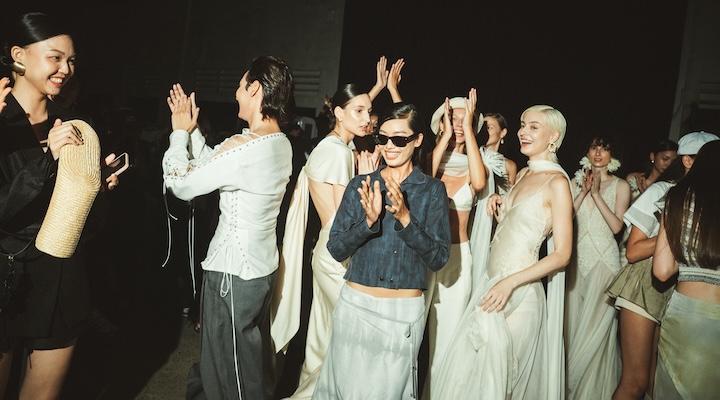
On the night of April 18, Rue Miche hosted its second annual runway show ‘Pulse’ at Ice Factory. The lighting ran in International Klein Blue, Rue Miche’s signature colour.
Inside the main runway zone lay a live symphony orchestra from the Soul Institute of Arts and French-Vietnamese DJ and producer Keight building a sound architecture that opened with something close to a heartbeat and escalated, across two hours, into layered techno and orchestral collision.
More than 400 guests were in the room. Regional media had flown in, including Vogue Philippines, L’Officiel Thailand, Esquire Thailand. The international guest list extended across Singapore, Thailand and further.
The show was structured in two chapters ‘Rhythm’ and ‘Surge’, presenting designs from 12 Vietnamese fashion brands, including White Ant, Marble Rose, Beuter and Stressmama.
“Pulse is a starting point, not an endpoint,” Vu said. “After the show, brands transition into direct engagement with customers at Rue Miche, driving both visibility and conversion. More importantly, it helps build longer-term relationships with their audience. Our purpose of the runway is not just only for awareness but also to hopefully drive sales engagement afterwards.”
The typical regional runway produces coverage, conversation, and a PDF of lookbook images. The brands go home, return to their existing distribution channels, and measure success in follower counts. Rue Miche is attempting something harder: to make the runway the beginning of a commercial relationship between brand and consumer rather than its own self-contained moment.
Vu references the models she watches most closely without apology.
“I closely observe models like Dover Street Market and Labelhood but not to replicate them, but to understand how they sustain a creative ecosystem over time and remain culturally relevant. What matters is not the format, but the ability to stay relevant while maintaining depth,” she said.
Labelhood, the Shanghai- based platform, has spent a decade building exactly this kind of runway-to-retail pipeline for emerging Chinese designers. It has survived long enough to become the infrastructure through which a generation of Chinese independent fashion found its commercial footing.
Dover Street Market operates a different kind of logic – editorial curation so precise that carrying a brand within its walls functions as a market signal in itself. Both models took years to establish the trust that makes them work. Rue Miche, in its second runway, is still early in that process. But the architecture it is building points clearly toward the same destination.
“The key difference is that Rue Miche wasn’t built by copying a global model, but by adapting it to the local context,” Vu said. “Vietnam is at a unique stage where local brands are maturing and consumers are increasingly open to new retail experiences. Rue Miche fits into that moment as a platform, not just a store.”
Quality over quantity
Rue Miche currently operates two locations, with no third on the immediate horizon.
“Right now, the priority is internal improvement over expansion,” Vu said. “Each space plays a different role, and the focus is on refining the experience, operations, and overall value before scaling further. Growth will come, but only when we can maintain the same level of quality at a larger scale.”
She said while Ho Chi Minh City is Rue Miche’s foundation and will remain central, the model has the potential to travel to cities with strong cultural exchange and emerging creative communities, whether within Vietnam or regionally.
“Right now, the priority is internal improvement over expansion,” she said. “Each space plays a different role, and the focus is on refining the experience, operations, and overall value before scaling further. Growth will come, but only when we can maintain the same level of quality at a larger scale.”
Rue Miche is not rushing toward anywhere. Which may be exactly why people keep rushing toward it. John K has his next trip half-planned already – same neighbourhood, one store he already knows he’ll visit again.
This story first appeared in the May 2026 issue of Inside Retail Asia magazine.