Walmart’s first quarter of fiscal 2027, which ended on April 30, continued its growth story across both its core and emergent businesses. The company generated revenues of $177.8 billion, an increase of 7.3 per cent year-over-year, a little lower (5.9 per cent) when adjusted for currency movements. Gross margin edged up slightly to 24.3 per cent and operating income by 5.0 per cent, while net after-tax profit was US$5.5 billion, an increase of 18.8 per cent from a year ago. The company returne
d US$4.1 billion to shareholders through share repurchases and dividends.
At the forefront driving revenue growth was, as usual, global e-commerce, which in the first quarter soared by 26 per cent to represent 23 per cent of net sales. The marketplace business grew by almost 50 per cent, and has now been extended cross-border to both Canada and Mexico. “Build one, scale globally” has become one of the company’s mantras, meaning create a new platform in one location and then transfer it to other markets. Another revenue stream experiencing rapid growth is membership: income was up 17.4 per cent.
Walmart and Sam’s in the US
Net sales in the US business, excluding Sam’s Club, reached US$117.2 billion, representing 66 per cent of total company revenues. Same-store sales, excluding fuel, were up 4.1 per cent, with transactions and average ticket both up in the low single digits. E-commerce sales increased by 27 per cent, while store fulfilment grew explosively. And there was another milestone too: Walmart completed its one-millionth drone delivery. Airdropping with drones is now available in 66 locations in four southern states: Texas, Georgia, North Carolina and Arkansas.
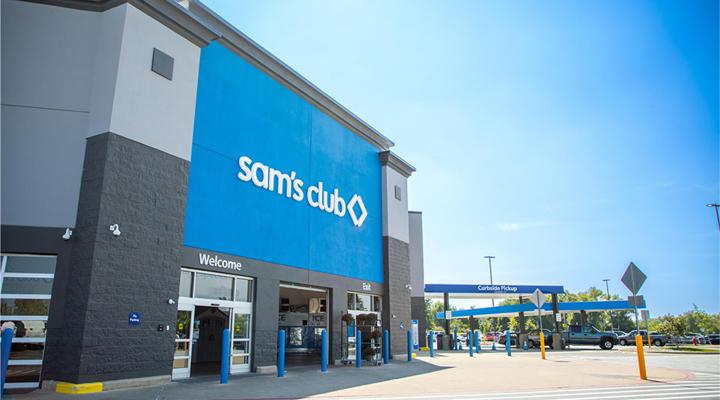
In the US, Sam’s Club kicked in another US$23.4 billion to the company’s top line, a growth rate of 6.1 per cent from a year ago. Excluding fuel, Sam’s comps were up by 3.9 per cent. E-commerce was up 23 per cent, and membership income was up 5.6 per cent.
CEO John Furner was again quick to extol the virtues of the company’s AI investments, and of the company’s AI shopping agent Sparky in particular. He told analysts on the company’s May 21 conference call that the technology was becoming more useful by the day. “You can now use Sparky in stores and automatically reorder items you have on repeat. Sparky even speaks Spanish these days. And as we’ve mentioned before, customers using Sparky have an average order value that’s about 35 per cent higher than non-Sparky customers.”
International, powered by China and Canada
Sales for Walmart International, which includes non-domestic Sam’s Clubs, rose 18.0 per cent to US$35.1 billion in the first quarter. Adjusted for currency movements, sales increased by 10.1 per cent. China was a major growth driver, with sales increasing by 23.1 per cent and comparable store sales by 13.1 per cent on a constant-currency basis. Canada also contributed heavily, with both sales and comps up north of 7 per cent.
Delivery speed is a constant theme
A constant theme pushed by company leadership is the role of speed, particularly delivery speed, in the e-commerce segment. Furner was at it again this week, telling investors that more than one-third of all US store-fulfilled deliveries in the first quarter arrived at the customer’s doorstep in under three hours. Globally, having nearly 11,000 retail locations that can be harnessed for e-commerce order fulfillment is a huge advantage. The narrative around international e-commerce is dominated by the delivery speed theme. “I’m so impressed by what the teams are doing to speed up delivery solutions in markets that are already high-speed,” said Furner. “In India, Flipkart now operates more than 800 micro fulfillment centers used for fast delivery, something we call Flipkart Minutes, and they’re delivering items in less than 13 minutes on average. And the team in China delivered over half billion units in Q1, with about 75 per cent of those arriving in under one hour.” CFO John David Rainey also chimed in on the speed theme. “Speed just continues to be something that we see our customers are valuing,” he said. “This was a bit of a milestone quarter insofar as 60 per cent of US households we can now serve within 30 minutes. And the importance of speed, the reason to highlight that is fast fuels frequency. When we see that we are able to deliver to customers in the timeframes that they expect, we see a much greater engagement with our customers.”
Maybe so, but the focus on speed has been too much for some governments in international markets that Walmart and its local delivery partners serve, including India and China, where authorities are becoming appalled at the safety hazards resulting from two-wheeler delivery drivers attempting to meet ultra-tight delivery schedules devised by routing technologies. Earlier this year, the Indian government went so far as to tell Flipkart and other delivery platforms to stop advertising 10-minute delivery times. However, customer expectations are now deeply embedded, and driver income depends on making the maximum number of deliveries in a day’s work, so the incentives are poor to change anything. The carnage continues not only in India and China but across Asia, where delivery on two wheels is the norm.
Scaling emerging businesses: getting to double-digit growth
Aside from the company’s core activities, it is scaling peripheral businesses that are now contributing heavily to the bottom line, including advertising and membership fees. CFO Rainey noted that these two categories contributed one-third of the company’s first-quarter earnings. Looking ahead, Walmart is aiming for annual revenue growth of 4 per cent and operating income of somewhere between 4 per cent to 8 per cent. The emerging businesses, scaling up fast from a low base, will help the company get there.
Even so, US consumers are under duress due to cost-of-living pressures. Rainey noted an interesting data point: in the latest quarter, customers at Walmart’s fuel stations filled up with an average of under 10 gallons for the first time since 2022. “That’s an indication of stress,” said Rainey. “We see with our customers that the high-income customer is spending with confidence in many categories, while the lower-income consumer is more budget-conscious and perhaps navigating financial distress.”
Further reading: Why is Walmart outperforming expectations despite tariff pressures?