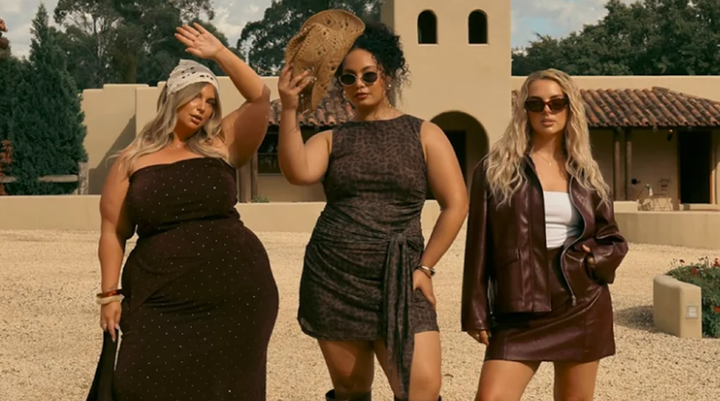
Earlier this month, Australian fashion brand Fayt The Label held an invite-only influencer event that was more of a house party than a retail activation. Held in Byron Bay, it gathered creators, customers and brand founders for a staged, two-night stay. But for founder Brittney Saunders, the real intention behind ‘Fayt Estate’ was to strip away the disingenuous, transactional feel of similar gatherings and instead focus on attention and conversation. Saunders, who built Fayt into a size-in
-inclusive clothing brand with more than half a million followers, was candid about the format she was pushing against. “A lot of influencer events have started to feel really transactional. You walk in, take a photo in front of a branded wall, grab a drink, maybe get gifted something, and leave. It’s content, but it’s not memorable.” Fayt Estate attempted a pivot from that custom. Eight community members were invited alongside creators, each given accommodation and access to the Fayte Estate festival experience without expectation of purchase. “It was less about hosting an event and more about building an experience people could move through, discover and feel part of.”
Fayt Estate landed at a moment when the credibility hierarchy in retail is being redrawn. According to a 2026 study by Walr for We Are Talker, 72 per cent of Gen Z consumers rank customer reviews as the most trusted influence when engaging with a brand, overtaking influencer content. It is a generational restructure that places weight on peer validation and lived experience over superficial endorsement. The logic behind removing the sales mechanism thus became clearer. Without the pressure to decide, consumers appear to engage differently, more slowly, critically and often more honestly.
Priscilla Hajiantoni, founder of Bangn Body, observed the difference in the brand’s tone at Fayt Estate. “Honestly, it felt more like hosting than retail,” she told Inside Retail. Without a checkout looming, behaviour seemed to relax. “People weren’t rushing or comparing, they were present, curious and open.” The absence of transactions ironically deepened engagement. In behavioural terms, the “reciprocity principle” is well established; when something is given freely, the emotional pull strengthens. In retail language, gifting builds affinity, while selling introduces friction.
Beatrice Laloli, founder of Eve Wellness, pointed to the quality of feedback that emerged in that environment. “You get a completely different level of honesty when there’s no transaction involved. People take their time, ask more considered questions, and engage with the product in a more curious way.” She said. “The nuance in how women talk about sensitive health topics when they feel comfortable, the questions they ask and the language they use helps shape what we do as a brand.” For digitally native brands, that nuance is difficult to replicate online. Surveys ignore sentiment and direct messages tend to be filtered, while in person, particularly in a setting designed to feel safe and unhurried, the language consumers use becomes more useful.
Long before Byron Bay, brands had been testing how far experience could travel. Coca-Cola replaced its own logo with first names in its “Share a Coke” campaign, turning a bottle into something personal, to be found and passed on. Red Bull sent Felix Baumgartner to the edge of space in 2012. IKEA invited customers to sleep inside its stores. Airbnb placed a floating house on the Thames. Nike built running clubs instead of campaigns. Each moved the emphasis from product to participation and in doing so, extended the life of the brand’s life far beyond the point of sale.
The Event Marketing Institute reports that 98 per cent of consumers feel more inclined to purchase after attending a live brand experience, while 74 per cent say such engagement makes them more likely to buy. The pathway to purchase, however, is no longer linear. What Fayt Estate suggests is that value can be built without immediate conversion, and that the memory of an experience may carry more substance than the act of purchase itself. It echoes the long-standing principles of the experience economy, where goods become props and the lasting impression becomes the product.
For Saunders, the ambition was not necessarily confined to the weekend. “At the core, what we were trying to create was something people would talk about after, not just post about in the moment.” The contrast between what is shared instantly and what is remembered, is where experiential retail is now being tested. As brands contend with diminishing returns on traditional influencer formats, the move is now toward environments that prioritise presence over vacuous promotion. Retail, in this form, may from now focus on the imprint it leaves behind.