It’s not unusual for a luxury brand to get China wrong. What’s unusual is getting it this wrong and at a time when trust, once lost, is incredibly hard to win back. Paris-based label Lemaire has been building toward this market for years. A store in Chengdu’s Taikoo Li opened in 2024. Then came its largest global flagship on Shanghai’s Wukang Road in January 2026. Beijing followed quickly after, with a second flagship in Sanlitun just two months later. The momentum was there. The issue b
ssue began with “Objets Senteur,” Lemaire’s first attempt at home fragrance. One piece, named ‘Tresse’, which is French for braid, is a woven linen object intended to hold fragrance.
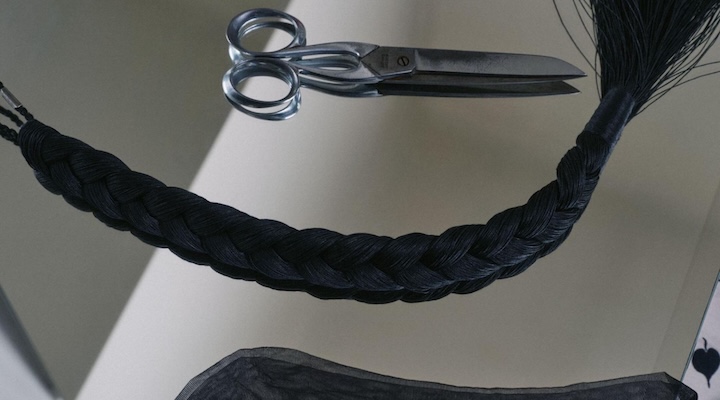
Not long after the campaign launched, images started circulating on Chinese social media. In one, a model interacts with the long braided object in a way that many felt echoed the Qing dynasty queue hairstyle. In another, the braid sits beside a pair of scissors. A third shows it draped over a button-down shirt.
Individually, these might seem like abstract styling choices. In China, they landed very differently.
When the Manchu-led Qing dynasty conquered China in 1644, the edict required all Han Chinese men to abandon their traditional hairstyles and adopt the Manchu queue: the front and top of the head shaved bare, the remaining hair at the back grown long and plaited into a single braid.
Traditionally, adult Han Chinese did not cut their hair for philosophical and cultural reasons. To shave the head was understood as an act of disrespect to one’s parents and, by extension, to one’s ancestors. The queue was originally a symbol of submission, but was also a sign of repression. The Qing Dynasty used it to show its dominance in China.
The still-life photograph of the Tresse placed beside a pair of scissors is the image that drew the most concentrated reaction, and for a specific reason.
Upon the fall of the Qing dynasty in 1912, Han Chinese men reportedly cut off their braids to signify defiance of Qing rule and liberation from the queue order. So when Lemaire’s campaign placed a braid beside a pair of scissors, whether intentionally or not, it unintentionally echoed a whole chain of associations: forced submission, the stripped identity and the moment of violent severance.
Over time, the queue became a symbol used by outsiders, especially in Western and Japanese depictions, to caricature China as weak or backward. That history lingers.
A longtime Lemaire admirer on the same platform wrote, “When I saw the braid accessory and how it was displayed, especially the one next to a scissor, I was utterly disappointed.”
The apology that did not land
Last Sunday, the brand issued a statement in both Chinese and English, admitting it hadn’t given enough thought to how it would be received.
“We recognise that we did not exercise sufficient awareness in considering how this piece might be perceived, particularly in light of diverse cultural perspectives and sensitivities,” it said.
But the apology didn’t land. Under Lemaire’s Weibo post, a majority of respondents questioned the sincerity of the apology, describing the incident as a matter of “cultural differences” as a deflection. Others called for a boycott and withdrawal entirely.
Lemaire is not the first brand to reach this juncture. Dolce & Gabbana’s 2018 chopsticks campaign remains the benchmark for how quickly things can unravel in China. Balenciaga, Dior, and others have faced versions of the same reckoning in China.
As Anais Bournonville, CEO of AB Advisory, who works with international brands on China strategy, noted in observations shared widely after the controversy broke: in her experience working with brands, the same objections to cultural review tend to recur. Teams point to past research. They point to strong sales. They assume that commercial traction signals cultural fluency. It does not.
“But even with flagship stores, brands make mistakes. In China, you need consumer review every quarter or the backlash is around the corner,” she shared.
Further reading: Inside Hermès’ strategy for profitable growth in a slower China.