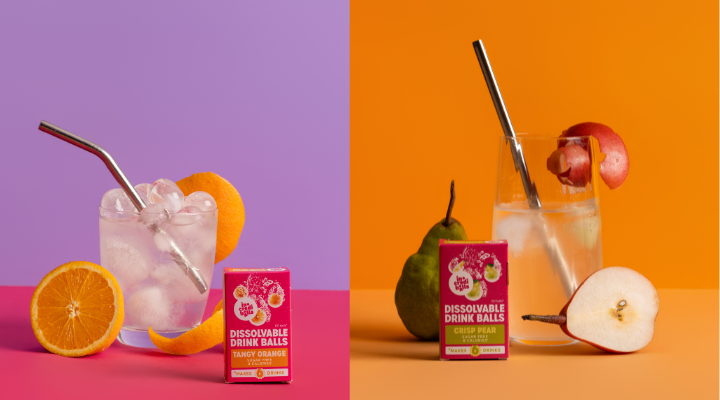
A New Zealand startup will launch a tablet-format beverage product aimed at reducing plastic use in the drinks sector. Incrediballs’ product marks the commercialisation of research developed over seven years.
Incrediballs consists of non-plastic effervescent drink tablets. It was developed by Brianne West, founder and former CEO of personal care company Ethique, following her departure from the business. The technology is based on a co-crystal stabilisation process developed at the University of Bradford, in the UK.
According to West, conventional effervescent tablets are unstable and require plastic or metal packaging to protect against moisture and air. She said stabilisation remains a challenge for pharmaceutical companies at commercial scale.
“It’s deceptively simple chemistry, but extremely difficult to control,” West said. “The patented system wraps active ingredients like citric acid and sodium bicarbonate with compounds such as nicotinamide and creatine, preventing the reaction from occurring until the tablet is fully immersed in water.”

When dissolved, each tablet produces a 350ml beverage with no added sugar. The format removes the need for bottled drinks and offers an alternative within a global soft drink market estimated at $1.42 trillion, which produces around 583 billion single-use plastic bottles annually. Industry data shows that recycling systems recover only around 10 per cent of these bottles.
An alternative to bottled drinks
Citing United Nations data, West said manufacturers have the capacity to produce about 20,000 PET bottles per second. At the same time, single-use drink containers account for around 45 per cent of litter in urban areas.
The tablets are packaged in paper-based material certified for home composting and without plastic laminates. The packaging can be composted or recycled. The company said it uses water-based inks and is assessing algae-derived alternatives.
Incrediballs was developed with input from more than 15,000 subscribers and social media followers who provided testing feedback. The business plans to expand into functional beverage formats using ingredients sourced from New Zealand, including manuka, kawakawa and kiwifruit extracts.

The company aims to change how the industry manufactures, transports and sells drinks. The focus is not on positioning the product as a niche environmental alternative. It has set targets to prevent 50 million plastic bottles by 2030 and 300 million by 2050.
From a logistics perspective, the non-liquid, non-plastic format reduces transport volume by more than 99 per cent, allowing higher product density per shipment. West said this could change export economics by lowering logistics costs.
Financial targets include revenue of $1 million in the 2027 financial year, with longer-term plans to build an export business with an annual turnover of $1 billion.
The first four flavours will be available for online orders from February 16. The company said it has received interest from supermarkets and FMCG retailers in Australia and New Zealand.
Initially, the business will focus on direct-to-consumer sales to establish brand positioning and understand customers, while partnering with selected independent retailers for testing. Feedback from this stage will be used to refine flavour, packaging and usage before wider FMCG and export distribution.
“We’re not trying to be niche or a travel product,” West said. “We want to be present on every drinks aisle.”