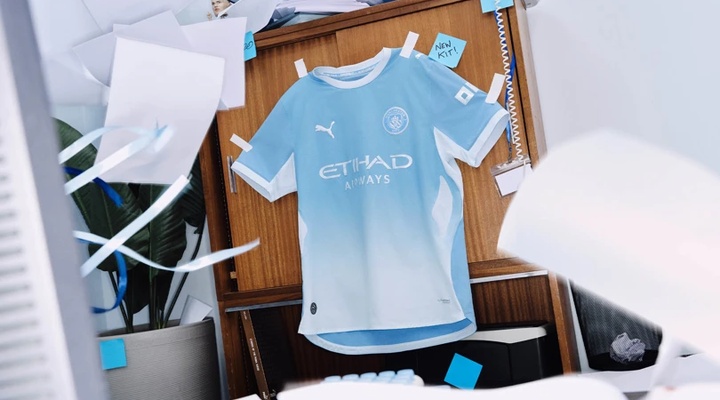
Manchester City and the English Premier League have massive followings in Asia, supporting merchandise sales that could be as high as US$1 billion or more. What are the chances of this taking a beating over the coming months? The potential ramifications of the Manchester City financial cheating scandal within English and European football are enough to give you a headache: trying to draw a mental perimeter around the ripple effects is like containing an oil spill with fishing nets. Pundits from
rom the sports, legal and journalism professions have spent the entire week since the announcement by the EPL Independent Commission speculating breathlessly about what the punishment might be if the charges stand up after appeal.
It has consumed the conversations of average football fans. Everyone has an opinion but what is exceptional about this situation is that the sheer enormity of it has no precedent, and every potential punishment has knock-on economic effects on everyone else in the football industry. It will actually go beyond the industry, since now the politicians are getting involved on both sides. Lawsuits will fly, and conspiracy theories will flourish. In a word or two, this is an absolute mess.
Rest assured that the effects of this fiasco will be felt throughout EPL-crazy Asia. But it promises to be more nuanced than in Europe. Sure, it will affect the brands, it will affect the sponsorships, and to some extent it will affect merchandise sales and retail employment. But will it be seismic? Probably not.
For starters, all of the top Premier League clubs have immense fan bases in Asia, and the EPL generally has a huge television audience week-in, week-out. Tickets for pre-season tours by City, their cross-town rivals Manchester United, Liverpool, Arsenal, Chelsea and other top clubs sell out within minutes. However, getting an accurate number for the following of each of these clubs isn’t really possible, although there are a lot of highly exaggerated claims out there. It’s easy to exaggerate your fan base because no one really knows how to measure it. If the term is defined very broadly, it could be closing on a billion.
In Southeast Asia, if you ask anyone in a bar, they’ll be able to tell you what team they support – everyone, it seems, has a favourite – but that doesn’t necessarily mean they watch any of the games or would even be able to identify a team by its kit or players when it took the field. The TV audience doesn’t really capture the fan base either. Suffice it to say that the following, broadly speaking, is in the hundreds of millions, with Manchester United at the top and Manchester City running about fifth. The reason City doesn’t have the fan base of the others is that much of its success has been of recent vintage, coinciding with the period of the charges it has now been nailed with. Comparing the brand of Manchester City with, say, Manchester United or Liverpool, is like comparing one of the popular modern designer brands with Louis Vuitton or Chanel: while City has had huge success and won everything over the past 15 years, it doesn’t have the longstanding pedigree of the other top clubs. This is not intended to be disrespectful to City; it’s simply how it is.
Annual merchandise sales for City in Asia are also impossible to pin down, with shirt sales estimates varying so widely that the numbers are virtually useless. What we do know is that with the arrival of global superstars like Erling Haaland at City in 2022 and his phenomenal exploits over the past four years, the revenue potential for the club in Asia has certainly increased in leaps and bounds. Overall though, even if no one bought another Manchester City shirt, it would hurt City but it wouldn’t move the needle much on overall EPL sales because the other clubs above them in the pecking order have such a powerful and longstanding draw. Fans deserting City would turn their affection to another team.
Brand damage
While a loss of sales power for Manchester City in Asia would not be economically catastrophic, there is also the possibility of ancillary damage to the image of the Premier League. Will fans desert the EPL and go elsewhere for their entertainment. The answer is almost certainly “no”, for two reasons.
First, the fan base in Asia is not underpinned by tribal loyalties: a fan in Shanghai or KL is not looking at football in the same way as a fan in Manchester, who would never change sides if his life depended on it. Rather, Asian fans are looking at the EPL for the pure entertainment value it provides; they want to see winners and stars and extraordinary exploits, and how these players got to be on the pitch is not really important, even if it was by massive financial chicanery in the back office. So long as City stays up in the Premier League and the current crop of players remains, then it is doubtful that their support, or that of the Premier League, would lose a beat even if they were found guilty on a thousand more charges.
Second, with the notable exceptions of Singapore and Japan, Asian countries don’t do well in global rankings of corruption. To many ordinary Asians, corruption is a way of life, or at least it creeps into their lives in particular transactions, and/or in dealings with particular institutions. When looked at through this lens, the problem that Manchester City has in front of it might be viewed as trivial and treated with a shrug by most of its Asian fans. They just want to be on a winner.
Now, if City were to be relegated from the EPL and many of their stars jumped ship (a realistic possibility), then they would surely lose a significant amount of their fan base and merchandise sales. In terms of knock-on effects to the EPL following, it would hardly make a dent though: unlike the English fans whose loyalty is anchored geographically, Asians can just shift their gaze to another club or clubs.
Bottom line: It is hard to overestimate how much damage could be done to the Premier League in England, and it affects clubs and fans well beyond there, but the football economy in Asia is not about to collapse.