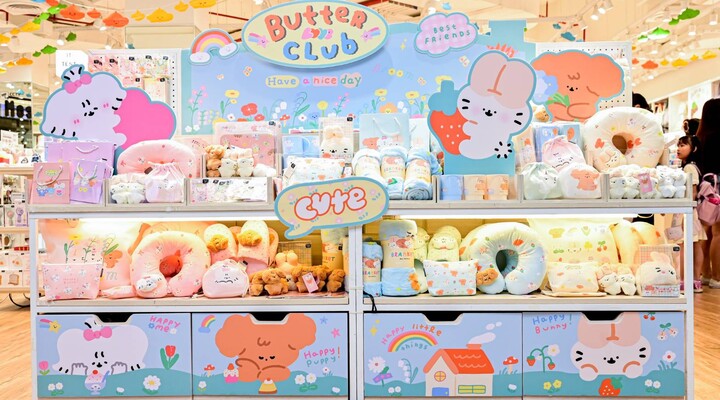
Moshi Moshi gave itself a pat on the back this month, spruiking its achievement of making it onto Forbes Asia’s “Best Under a Billion” list of high-performance small and mid-sized companies for the second consecutive year. The ubiquitous lifestyle retailer’s second-quarter and first-half results were made to match, with continuing strong growth in the key metrics of sales, same-store sales, gross profit and net profit on the bottom line. It finished the quarter with 218 stores, 37 mo
, 37 more than a year ago, across all but a small handful of Thailand’s 76 provinces and Greater Bangkok. Operating revenue for the second quarter was up 17.2 per cent year on year to 956.1 million Thai baht (US$29 million), once again consistent with the company’s oft-repeated goal of a consistent 15–20 per cent growth rate for the next several years.
The gross profit margin rose an impressive 140 basis points to 56.4 per cent, and net profit rose a tad over 20 per cent to reach 161.86 million baht (US$4.9 million). For the full first half, operating revenue grew 17.3 per cent to 1,654 million baht (US$50 million), and net profit grew by 21.5 per cent to 352.83 million baht (US$10.7 million).
Same-store sales grew 4.0 per cent in the second quarter, a good achievement given it had to clear a base-year growth rate of 15.2 per cent. If you take the two-year stack and split it in two, you get an average annual rate pushing double digits, which would be the envy of most retailers.
The company was particularly chirpy about its back-to-school performance and its ability to launch new products aligned with the needs of its target customers, which Moshi’s leadership believes is the bedrock of its competitive advantage.
Wholesale growth still sluggish as work goes on at the Platinum Fashion Mall
The wholesale side of the business, which generates 11 per cent of sales, is growing more slowly. However, this may be a temporary phenomenon because a large part of the wholesale revenue is derived from its presence in the Platinum Fashion Mall in downtown Bangkok, which is currently suffering from unusually bad congestion due to adjacent bridge construction. The congestion, in turn, is reportedly causing tour buses to avoid the area and also dampening customer arrivals on foot.
Moshi Moshi’s store fleet expansion is not yet running out of headroom despite the rapid pace of openings and the fact it already has stores in most of Thailand’s high-quality regional malls and many of its community malls as well. Central Pattana, Central Retail’s Robinson lifestyle malls, Berli Jucker’s Big C, and CP Axtra’s Lotus’s are among Moshi Moshi’s most important mall landlords and collectively offer about 500 locations, though realistically fewer, because many of these malls are in overlapping or low-potential markets.
However, there are also around 150 universities, and many of these could support a Moshi Moshi stand-alone store, such as the one at the southern end of Chulalongkorn University’s campus in Bangkok.
The company also sees an opportunity to drive higher e-commerce sales because it currently derives only 3 per cent of its sales online, with a presence on Lazada, Shopee and TikTok.
New product introductions are a key competitive advantage
Store fleet expansion is one thing, but what really makes Moshi Moshi tick and gives it a key competitive advantage is attracting repeat visits with the breathless launch of new products within its 13 merchandise categories – home accessories, bags, stationery, cosmetics, fashion accessories, beauty, apparel, snacks, toys, plush toys, IT gadgets, pet accessories and “Others”.
It currently offers more than 25,000 SKUs and introduces new ones at the rate of 1,000 a month. The products are well designed but very accessibly priced, and the company excels at presentation and creating a fun, buzzy in-store experience.
The longer-term outlook: when the cupboard gets bare
Moshi Moshi’s target of 35 net new store openings for 2026 was already half-realised by the end of the second quarter. Aside from the expansion, the company is renovating and, in some cases, expanding existing mall stores. The company’s leadership also wants to make more of an impression on the pre-teen market.
It is fair to say that there is enough potential to keep the expansion going at the current pace for several more years, picking off locations in provincial markets, backfilling Bangkok and adding campus-adjacent locations. A growth rate of up to 20 per cent in selling space and revenues would seem achievable.
After that, the cupboard will begin to get bare, and its continued expansion would likely involve establishing a beachhead outside Thailand. Neighbouring countries in Southeast Asia would be natural targets, particularly Vietnam, Indonesia and Cambodia. All three share a similar profile to Thailand: large, young urban populations with growing but still constrained incomes, meaning strong demand for cutely designed, affordable items in Moshi Moshi’s merchandise categories.
These three countries have another important thing in common: the right real estate platform. Moshi Moshi is, above all else, a mall retailer, and its main location requirement is an air-conditioned mall, which the trio of countries already has plenty of, with more opening at a steady rate.
Even Cambodia, with a much lower population than Vietnam or Indonesia, already hosts one of Moshi Moshi’s key potential regional competitors, Oh!some, from Singapore. Oh!some has a store in each of Aeon 1, Aeon Sen Sok and Aeon Meanchey, all in Greater Phnom Penh. Oh!some also has a number of stores in Vietnam, in Hanoi and Ho Chi Minh City, and it has even set up shop in three locations on Moshi Moshi’s own back doorstep in Bangkok.
Clearly, Moshi Moshi still has a tight clamp on Thailand, competitively speaking, as the first mover, but it should regard the opportunity elsewhere in Southeast Asia with some urgency, given that some formidable competitors are eyeing it up. For lifestyle products, the demand is huge and growing in the region, but so too is the competition, and Moshi Moshi can’t afford to wait too long.
Further reading: What is driving Moshi Moshi’s growth amid mounting pressures?