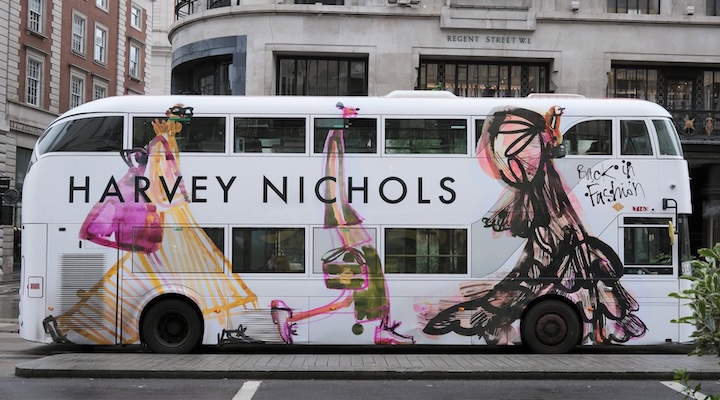
Frasers Group has confirmed on Thursday it has acquired Harvey Nichols out of administration for an undisclosed sum. The deal ends 35 years of ownership by Hong Kong businessman Sir Dickson Poon, who bought Harvey Nichols in October 1991 from Britain’s Burton Group for £53.6 million, and hands Mike Ashley’s retail group control of the iconic Knightsbridge store. The business was bought from FTI Consulting, which was appointed as administrator, in a pre-pack deal. Frasers beat rival bi
bidder Next to the asset.
Harvey Nichols will join Frasers Group’s luxury ecosystem alongside Fannels, The Webster, Gieves & Hawkes and Mile.
Mike Ashley-founded Frasers Group made a US$54 million bid for the retailer in late July. Harvey Nichols was looking for £50 million to £60 million. Ashley told the Financial Times last week that he would be surprised if it fetched more than £40 million, and said the business was in a “death spiral”.
“Since 1831, [Harvey Nichols] has helped define UK luxury retail. We see real potential in what it can become next,” Michael Murray, CEO of Frasers Group, said.
“That said, we’re not pretending the road ahead is simple. The business cannot continue in its current form. Getting it right will mean tough decisions, significant investment and a relentless focus on long-term growth, and we’re prepared to make those calls to give it the best possible chance.”
What Frasers has actually bought
The deal covers six UK stores – the newly refurbished Knightsbridge flagship, Manchester, Birmingham, Bristol, Leeds and Edinburgh – along with the online business, existing inventory and more than 1000 employees. All six will keep trading until further notice.
Harvey Nichols’ international franchise agreements form part of the transaction. The franchised stores in Hong Kong, Dubai, Riyadh, Kuwait and Doha will continue trading under their existing licensing arrangements. Earlier reporting during the sale process suggested the overseas stores sat outside the deal. Yet, the confirmed terms say otherwise.
Two assets were treated differently. In Dublin, Frasers acquired only certain assets, including stock and store fixtures, and said discussions about the business are continuing while it supports trading at the site. The OXO Tower restaurant in London was not included and has been sold to a separate buyer.
Frasers said Harvey Nichols has faced sustained trading and operational difficulties, and warned that significant restructuring and integration will be needed. It plans a review of the store portfolio, organisational structure, operating model and cost base. Chief executive Michael Murray said the turnaround would require tough choices, including accepting “a smaller business in the near term”. No figures were given for job cuts or store closures.
Julia Goddard, who remains chief executive of Harvey Nichols, called the deal an important milestone and pointed to the past year’s work to reposition the business and invest in the flagship.
What the accounts show
Four Harvey Nichols companies filed accounts this month covering the same 52 weeks to March 29, 2025.
Broad Gain (UK) Limited is the private company that owns the entire business. It reported sales down 10 per cent to £184.8 million (roughly US$250 million). Its loss after tax was £48.7 million, up from £34.1 million the year before.
Harvey Nichols Group Limited wrote off £105.3 million and posted a £104.9 million loss. Harvey Nichols and Company Limited, which runs the Knightsbridge flagship and the head office, wrote off £169.1 million and posted a £177.6 million loss.
Julia Goddard, a director of Harvey Nichols Group, stated in the filings that the group would cease trading if no sale was completed and no new funding was secured. The accounts were prepared on a break-up basis. The directors also confirmed that one or more of the offers received would require the business to enter administration before any sale could proceed.
The reasons it got here
Harvey Nichols opened in Leeds, Birmingham, Edinburgh and Manchester between 1996 and 2003, and added Bristol in 2008. However, the formula did not travel. Knightsbridge worked because of its address, the tourists, and the great wealth within walking distance. In contrast, the regional shopping centres, with the same narrow product range and high running costs, drew neither the visitor numbers nor the per-customer spending needed to pay for themselves. Three decades on, the London flagship still generates a disproportionate share of sales while the regional stores absorb rent, wages and stock.
The second is the Asian customer. Here the company saw the change early but did not act fast enough. In November 2023, Poon closed the 60,000sqft Harvey Nichols at Landmark in Central Hong Kong and moved everything to Pacific Place. His explanation covered the whole problem: mainland Chinese visitors were no longer coming to Hong Kong mainly to shop, the price gap with the mainland had narrowed, and Hong Kong residents were holidaying overseas. The same shift hit London, where the Chinese and Gulf shoppers who once treated a Knightsbridge afternoon as part of a European trip now buy at home, or in Paris and Milan.
In addition, Britain scrapped its VAT refund scheme for tourists in January 2021, leaving London the only major European luxury capital where visitors cannot claim a VAT refund on their shopping. Retailers and airports have lobbied to bring it back ever since. The Association of International Retail argues that restoring it could recover £11 billion in visitor spending. Nothing has changed. For a store that depended on expensive purchases by price-sensitive tourists, being permanently 20 per cent more expensive than Paris was close to fatal.
Why Hong Kong has barely felt it
Poon bought Harvey Nichols in 1991 through Dickson Concepts, his Hong Kong-listed company. By the time the business collapsed, the UK operation sat under Broad Gain (UK) Limited, the private vehicle Poon used to take Harvey Nichols off the London Stock Exchange in 2002, six years after listing it. Dickson Concepts’ own filings treat the Harvey Nichols group as a related party rather than a subsidiary. Minority shareholders in the company have been largely shielded from the British losses, which Poon has absorbed personally.
Dickson Concepts runs the Pacific Place store and the Beauty Avenue chain, and distributes Chopard, Tod’s and Roger Vivier across Hong Kong, Taiwan and Mainland China.
What has changed is who sits on the other side of that licence. Dickson Concepts now operates a Harvey Nichols store under an agreement held by Frasers Group. Poon’s Hong Kong company licenses the name from Mike Ashley. Frasers has said the arrangement will continue as is, but the licence terms are up for renewal, and the new owner has been explicit that everything is under review.
What happens next
Ashley had already described his thinking before the deal closed: keep London and Edinburgh as Harvey Nichols, and look at converting some of the remaining British stores to House of Fraser or Flannels, both of which he owns. Frasers has not confirmed that plan, but its statement on Thursday committed to rationalising the store portfolio, and industry analysts expect Knightsbridge and Edinburgh to be the two most defensible luxury locations.
The largest unresolved question is the Knightsbridge building itself. The lease is understood to have about five years left to run, and Cadogan, the dominant landlord in Knightsbridge and Chelsea, owns the freehold. Cadogan has declined to comment on its plans. Frasers has therefore bought a flagship it may not control by the early 2030s, with the options being a lease extension, a redevelopment partnership, or a move.
Bidders were told during the process that they would need to commit up to £60 million in additional funding, and industry insiders believe the actual figure is higher. Frasers is understood to have discussed a commitment to pay outstanding money owed to brand partners. That directly addresses the damage Fraser did to its own reputation in 2024, when it bought the online retailer Matchesfashion and quickly wound it down, leaving suppliers unpaid. Whether the luxury houses keep supplying Harvey Nichols is the test that matters, because they control their own distribution and can simply decline.