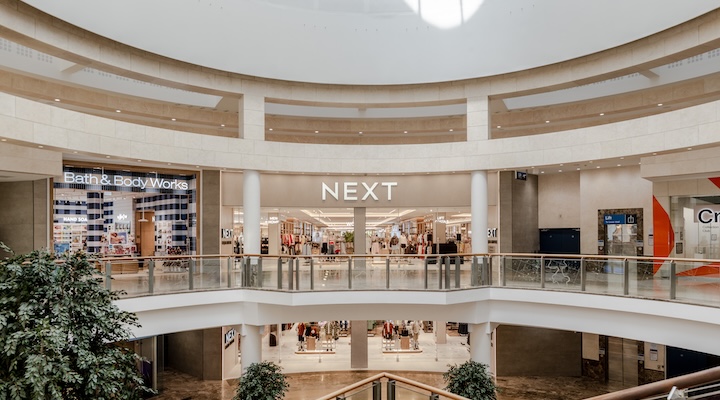
In the space of a week, British retailer Next made two moves that seem to pull in opposite directions. The retailer opened the biggest store in its near 45-year history then told the market that its shops were selling less than they did a year ago. Next’s flagship store Spanning 132,000 square feet at Bluewater in Kent, Next’s new flagship is the centre’s first new anchor since 1999 and triples the space Next held there. Of the new total, 83,000sqft is a trading floor, spre
oor, spread over two levels, with womenswear, menswear, childrenswear and home each given their own identity inside a single design scheme. Dalziel & Pow, Next’s design partner for 19 years, drew it up.
Inside the store, a neutral palette runs through both floors, with colour used to help people find their way – soft aqua in menswear, a warm pink blush in womenswear, deeper greys anchoring home, and glazed finishes adding some depth.
Lighting is built into the architecture, the ceiling details and the merchandising fixtures, while atrium skylights bring daylight into the middle of the floor plate.
Mark Frankland, creative director of environments at Dalziel & Pow, said the materials were chosen to be ones shoppers might have at home, and that while the store has “a premium feel”, it is meant to put customers at ease. The fixtures are adaptable, which matters more than it sounds. It lets Next move space between departments as ranges change without paying for another fit-out.
At just over 20,000sqft it carries a far wider furniture range than a standard Next store, with branded roomsets from Laura Ashley, Made and Rockett St George, and it opens onto the rear car park so that large purchases can be walked straight out. Bath & Body Works, which Next operates in the UK, has taken a 2000sqft unit alongside with its own entrance, one of the brand’s first premium-concept installations here. There is a Costa cafe inside the store, built to the chain’s latest design. Bluewater is also the first Next shop to stock Seraphine, the maternity brand Next bought last year, in its womenswear department. Landsec, which owns the centre, called the deal a powerful endorsement of physical retail.
The maths behind the box
Next’s own trading statement, published six days after the doors opened, made that endorsement look more complicated.
The brand’s store full-price sales were down 1.7 per cent across the first half. The guidance it set in March has not moved: like-for-like store sales down 3.0 per cent this year, store profit down from £193m to £181m, and store margin down from 10.2 per cent to 9.7 per cent.
The company is buying good space cheaply, and it has rewritten its investment rules to do so.
In its results for the year to January 2026, Next admitted that the 15 stores it had recently opened were running 12 per cent behind the sales targets used to approve them. Thirteen of the 15 missed. The company gave three reasons. It had barely opened space in years, so its instincts were formed in better times. Shoppers no longer move from town centres to out-of-town parks the way they did between 1995 and 2010. And, most usefully for anyone who reads retail appraisals, its own forecasts had been stretched to clear the hurdle they were being measured against.
The stores made money anyway: a branch contribution of 17 per cent and an internal rate of return of 32 per cent. What they missed was the 24-month payback Next had always insisted on. So rather than stop opening, Next changed the test. New stores now have to show a forecast internal rate of return of at least 27 per cent, which works out at roughly 30 months on a five-year lease.
Sales per square foot have fallen by about 30 per cent over ten years, and rents have followed most of the way down. Fitting out a shop, though, now costs 32 per cent more. Next’s answer is to spend less on the fit-out.
“Gone are the days of replacing a perfectly good floor finish” simply because it is off-brand, it told shareholders.
Thurrock Lakeside, opened in July 2025, was the prototype for the format now appearing in Newcastle, Canterbury, Ripon and Bluewater, and it absorbed the cost of developing it.
Stores now account for 32 per cent of full-price sales, against 46 per cent for UK online and 22 per cent for international. And the group behind the sign above the door is no longer one brand. Its own brands and licences turned over £386m last year, up 49 per cent, while other people’s brands make up a fifth of full-price sales. That is why a store this size is worth building: the roomsets, the Seraphine launch and the beauty concession turn Bluewater into a physical version of Next’s multi-brand online business Label and give it enough merchandise to fill 63 per cent of the total footprint.
The growth, though, is somewhere else entirely. International online sales rose 35 per cent last year and 36.9 per cent in the second quarter, against 2.8 per cent in the UK. Next buys that growth. Overseas digital marketing has gone from £23m to £69m in three years, and every pound spent has to return £1.50 in cash profit. At the moment it returns £1.75. Marketplace partners – Zalando, About You, Amazon and Nordstrom among them – take a third of international sales. Another £307m is going into warehouse capacity at Elmsall over three years.
Two lessons here travel to Asia. Bluewater shows what can be done with the region’s ageing department store floors: one omnichannel retailer takes the whole plate, fills it with several brands and a cafe, and pays rent according to what it sells. The second is Next is expanding into Asia without buying anything at all. It works through franchise partners and cross-border marketplaces. At its half-year briefing in September 2025, it said it would launch with at least one major Asian aggregator in the first half of this year, and it has not said publicly whether that has happened.