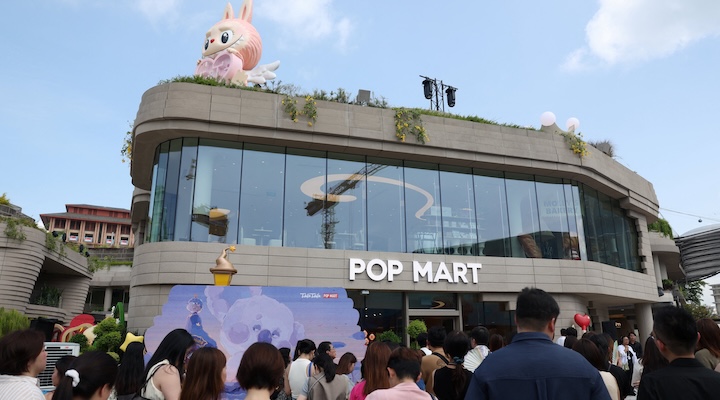
The toymaker behind the Labubu phenomenon, Pop Mart, has opened its first dessert concept outside China at Resorts World Sentosa in Singapore. Pop Mart took over a two-storey standalone villa opposite Universal Studios Singapore. While the ground floor is a retail store, the upper floor houses the brand’s first Pop Bakery in Southeast Asia. The menu includes a Twinkle Twinkle coconut mousse, a Puck ‘xiao long bao’ dessert of soy milk panna cotta with biscuit-stick chopsticks, and Lab
Labubu butter cookies.
“This new store at Resorts World Sentosa brings our characters to life in a space where fans can shop, discover and immerse themselves in the Pop Mart universe,” Justin Moon, Pop Mart’s chief growth officer, said at the opening.
Zhang Xiaoyang, who heads Pop Bakery, told Reuters the company is exploring bakery openings in Europe and the US, with timing dependent on “issues like local supply chains”, alongside planned dessert shops in Thailand, Indonesia and Malaysia. The Sentosa menu runs to 45 character-themed items priced between S$5 and S$32.
The Pop Mart Sentosa is also the second permanent Pop Bakery after the first one opened in China’s Qinhuangdao in April.
Licensing is the industry norm. Pop Mart is not doing it
Disney is the largest character business on earth by a measure that flatters it enormously, with an estimated US$62 billion of retail sales of licensed products in 2024, according to License Global’s Top Global Licensors ranking. Almost none of that is Disney’s revenue. Third parties make the lunchboxes, the pyjamas and the birthday cakes; Disney books a royalty as the goods go past.
Sanrio runs the same machine at a smaller scale. Hello Kitty’s owner entered the same top ten with US$8.4 billion of licensed retail sales, while Sanrio’s own group revenue for the year to March 2025 was 144.9 billion yen, roughly US$930 million. The character earns most of its money in other companies’ tills.
Pop Mart has built the opposite structure. It designs its characters, manufactures them, distributes them and sells them through its own universe.
Hu Jian, the Pop Mart vice-president who runs Pop Land, has described the Beijing park as a live platform for testing how IP converts into physical experience. Visitor numbers rose roughly 70 per cent year on year in 2025, and the enlarged park began reopening on 30 April ahead of the Labour Day holiday, with a second phase due in 2027. Chief operating officer Si De has called theme parks the company’s “huge dream”, and a Labubu film is in early development with Sony Pictures and Paddington director Paul King.
The bakery is not really a margin business, least of all in Singapore’s cut-throat F&B market. Entry to the Twinkle Twinkle meet-and-greet sessions, held three times a day from Thursday to Monday, requires a reservation and a minimum spend of S$40 per person and S$80 per table in a single transaction. Pop Mart has, in effect, put a price on proximity to its characters and bundled it with food.
Dessert is only the newest format in a fast-widening portfolio. Pop Mart entered jewellery in June 2025, when its owned brand Popop opened its first permanent store at Shanghai’s Grand Gateway 66, following a soft launch there from 30 May. Each new format – jewellery, film, dessert – stretches an organisation whose core competence is designing and distributing toys. Nor does dessert answer the underlying question of whether Pop Mart can mint another Labubu. It merely buys time and touchpoints while its six IPs, including Molly, Skullpanda, Crybaby, Dimoo and Twinkle Twinkle, mature beneath the flagship.
But the direction of travel is coherent. Pop Mart is trying to migrate from selling objects to operating a character universe with multiple tills: toys, tickets, screen rights and now sugar. The company that taught a generation to pay for the thrill of not knowing which figure is in the box is betting the same fans will pay S$18 for a Labubu “David” art cake they can see perfectly well.
Last year, Pop Mart’s revenue was up 184.7 per cent to 37.12 billion yuan (US$5.4 billion), gross margin at 72.1 per cent, and net profit roughly quadrupling.
Yet when those results landed in March, the market’s response was a share price fall of more than 20 per cent in a single session. The problem was not the numbers, as The Monsters series alone generated 14.16 billion yuan, around 38 per cent of group revenue. However, investors looked at a once-in-a-decade hit and wondered what would happen when it cooled.
And it is already cooling at the edges. Pop Mart’s first-quarter 2026 update showed revenue up 75 to 80 per cent year on year, but growth in Asia-Pacific outside China slowed to 25 to 30 per cent, and management flagged a quarter-on-quarter decline in overseas sales, attributing it to “inadequate customer accumulation” abroad.
Founder and chief executive Wang Ning has described 2026 as a “maintenance year”, and HSBC has trimmed its growth forecasts. In that light, the Sentosa villa is the answer to the concentration question: If the risk is that any single character fades, the hedge is to make the characters’ world the product.
Further reading: Pop Mart’s plushie paradox: The rise, peak, and reckoning of China’s toy titan.