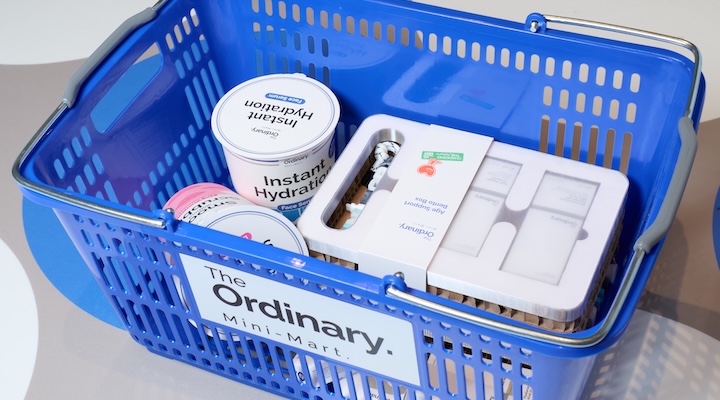
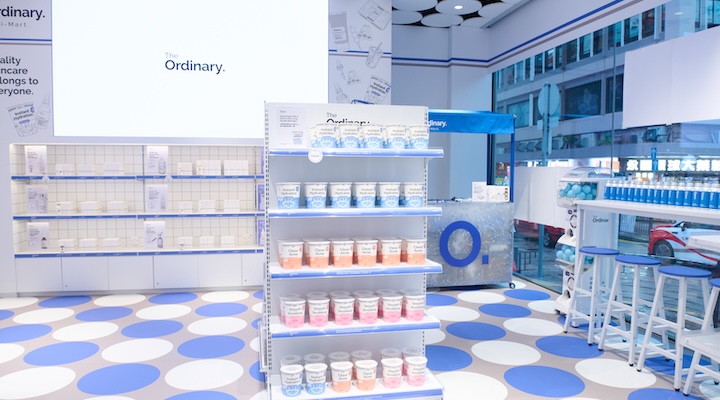
For seven days in late June, the @cosme flagship on Ashley Road in Tsim Sha Tsui was handed over to a convenience store that sold no groceries. Canadian skincare brand The Ordinary brought its mini mart pop-up store concept to Hong Kong for the first time. Inside the store, serums were stacked like snack shelves, and other products were displayed in a refrigerator and in cup-noodle blind boxes. The same month, the brand built a desert inside Kuala Lumpur’s GoDown Arts Centre and invited
ed Malaysians to walk from simulated arid heat into a cooling oasis at its Hydration Lab.
Then, on July 17, back in Hong Kong, it opened a permanent second store at 42A Hollywood Road in Central, complete with a mural by local artist Cherie Kwok.
Inside Retail spoke with Hyuna Kim, Asia Pacific brand director at Deciem, The Ordinary’s parent company, about the economics of ephemeral retail, what Japan proved, and when a pop-up earns the right to become permanent.
Inside Retail: Pop-ups are inherently short-lived. The Hong Kong Mini Mart runs just seven days. What’s the strategic logic of pouring resources into something so temporary, and how does scarcity work in your favour here?
Hyuna Kim: For us, the true value of an activation isn’t measured by its physical lifespan but by the lasting conversations and consumer connections it creates.
Launching our very first pop-up with a premier retail partner like @cosme naturally requires working within highly precise parameters, including specific scheduling windows and focused resource allocations. While a seven-day window presents an operational sprint, it also sharpens our focus, creating an intentional, high-impact moment of curiosity and engagement for the local community.
Between immediate foot traffic, creator storytelling and digital sharing, the ripples of this Hong Kong activation will travel much farther and last much longer than the physical space itself. It’s an agile, high-impact blueprint that lets us test the market, build deep partner alignment, and set the stage for longer-term experiences in the region.
IR: You’ve run Mini Mart activations in Tokyo and Osaka, and this month you’re opening the Hydration Lab in Kuala Lumpur alongside the Hong Kong Mini Mart. Can you share what the Tokyo and Osaka Mini Marts delivered in terms of commercial performance or brand lift that gave you the confidence to expand the concept?
HK: The response we received in Japan exceeded our expectations. Visitors actually took time inside the store to read about ingredients, ask great questions, and share the experience. This authentic engagement even captured the attention of a local news channel, proving that authentic activations without celebrity endorsement can still achieve that level of coverage organically.
Of course, retail performance matters, but we also measure success by the quality of those interactions and the trust we build. Seeing that a science-first, transparent dialogue could command that level of commercial success and media traction gave us immense confidence to bring the concept to new cities, while tweaking the details to make sure it feels relevant to each community we meet.
IR: The Hydration Lab and the Mini Mart are two very different creative worlds. How do you keep a coherent brand voice across both?
HK: The creative expression changes, but our purpose stays exactly the same. Whether you’re in the Hydration Lab or the Mini Mart, the goal is simply to make skincare knowledge easier to access. We always start with the same question: how do we help people understand the science behind a formula so they can make the best choices for their own skin? Both spaces take complex concepts and make them simple and fun. That’s the common thread.
IR: How do these markets differ in how consumers discover and buy skincare, and how does that shape what you build in each city?
HK: Every city has its own rhythm and cultural context, so we never just copy-and-paste an experience. While the underlying desire for honest information and ingredient education is universal, our job is to meet local communities exactly where they are. We want to ensure they feel truly seen and understood.
We achieve this by embedding thoughtful, localised elements into our activations to surprise and delight consumers. For example, for the Japan Mini Mart, we designed custom onigiri-shaped lip balm packaging, while for Hong Kong, we reimagined a beloved local item using a playful cup-noodle concept.
This commitment to cultural relevance extends beyond retail spaces and directly into our brand voice campaigns. In our recent “The Ordinary Dictionary” campaign, we tailored our messaging to reflect the distinct social fabric of each market. In Hong Kong, where family bonds run deep, our headline read, “Saying ‘I love you’ to your family should be ordinary.” Meanwhile, in Thailand, addressing modern work-life culture, we went with, “Leaving work on time without feeling guilty should be ordinary.”
IR: What’s the single moment or interaction in these pop-ups that you most want a visitor to remember and talk about afterwards, and how did you design for it?
HK: First and foremost, we want people to leave with a new understanding of their skin. Skincare science can often feel clinical or intimidating, so we designed elements of these spaces to demystify complex formulas and prioritise education.
Our ultimate goal is to make this knowledge accessible to everyone. To achieve that, we intentionally used a sense of playfulness as our vehicle at Mini Mart and Hydration Lab. We want our customers to have fun because fun is approachable, memorable, and naturally shareable. Whether they are exploring Mini Mart or visualising how moisture behaves inside the skin barrier at the Hydration Lab, we want them to have a fantastic time.
By wrapping ingredient education in an engaging, joyful environment, the learning happens naturally. If people walk out having had a great time and saying, “I never thought about skincare that way before,” we’ve achieved what we set out to do.
IR: Experiential retail is expensive and hard to scale. How do you justify the investment internally, and at what point does an activation become a permanent retail format rather than a limited run?
HK: We don’t view these as just temporary experiences. They’re platforms for us to talk to our community. When we evaluate them, we look at the whole picture: retail performance, word of mouth, social conversation and how effectively we shared skincare education. Right now, keeping them temporary gives us the flexibility to experiment and learn what works best in different markets.
IR: Looking three to five years out, what role do you want experiential retail to play in The Ordinary’s growth in Asia, and what would tell you this approach has fundamentally worked?
HK: We want these spaces to keep making skincare knowledge open to everyone. As our community in Asia grows, we want to give people more space to ask questions, test formulas, and build real confidence in their daily routines. For us, success isn’t just about high foot traffic. It’s when more people understand what makes a formula work, feel empowered to choose what’s right for them and see us as a trusted resource. If we’re helping people access better skin health through better understanding, it’s working.
Further reading: Why The Ordinary opened its first bricks-and-mortar store in Australia.