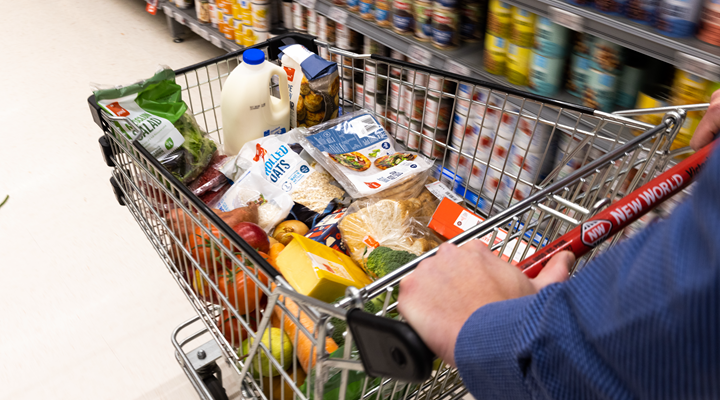
The National Party has promised to force the structural break-up of Foodstuffs if re-elected later this year, a move it says would lower grocery prices and ultimately benefit consumers.
Under the proposal, New World and Four Square would be separated from Pak’nSave, creating two nationwide chains. Alongside Woolworths, this would turn New Zealand’s grocery duopoly into three major chains that compete with each other. The policy suggests approval for the long-desired Foodstuffs plan to merge its North Island and South Island co-operatives before a banner split.
National will give the Commerce Commission six months to review the plan and determine whether the separation can work in a way that benefits consumers. If the market watchdog recommends the separation, the party will legislate to implement it.
According to National’s finance and economic growth spokesperson Nicola Willis, New Zealanders are paying more than they should for groceries because supermarket competition is too weak.
Willis cited independent analysis that the proposed restructure would lower grocery prices by 3.5 per cent after one year and 5 per cent after six years, with an estimated $12.6 billion in consumer benefits over 20 years.
Willis said owners of a Pak’nSave, New World or Four Square would not be forced to sell or rebrand their business. They would retain ownership, continue to operate under their existing brands, and remain part of a larger group with the scale and infrastructure to support their store.
Other parties’ approaches
Earlier this month, the Green Party was the first to propose splitting up Foodstuffs. Its approach was different, proposing the government spend $2.8 billion to buy 120 existing supermarkets and create a new publicly owned chain called ‘KiwiMart’.
The party argued that traditional methods of attracting a third corporate competitor had failed.
“There are only so many places in a town where a supermarket can go, and Woolworths and Foodstuffs have seen to it that these sites are locked up,” it previously said. “We’re not short of supermarkets, we’re short of competition.”
The Greens’ proposed policy also included banning price gouging at supermarkets, increasing funding and powers for the Commerce Commission, and an annual Fair Food Fund of $150 million for community-led food security.
In light of the National Party’s announcement, the Labour Party on Wednesday also vowed to crack down on companies that charge New Zealanders excessive prices for essential goods and services. However, this has been viewed as the weakest proposal among the three.
‘A concerning move’
BusinessNZ has described the National Party’s plan as a “concerning move” that sends a “chilling signal” to businesses that the Government can break up businesses.
“New Zealand has long benefited from a reputation for regulatory stability, respect for property rights and predictable policy settings,” said BusinessNZ director of advocacy Catherine Beard. “Measures of this nature risk undermining that reputation at a time when New Zealand needs investment, productivity growth and economic confidence.”
Beard said any proposal to structurally separate Foodstuffs would require rigorous scrutiny of unintended consequences.
“BusinessNZ is strongly pro-competition and supports measures that genuinely improve choice and put downward pressure on prices. But we remain unconvinced that structural separation is the best way to achieve those goals.
“Supermarkets rely heavily on scale across purchasing, distribution, logistics, technology and other infrastructure. If structural separation reduces those efficiencies or duplicates costs, there is a risk that some of those costs ultimately find their way to consumers,” she said.
Beard noted that the grocery sector has already faced regulatory intervention, including the Commerce Commission market study, the establishment of the Grocery Commissioner, a regulated wholesale regime and the Grocery Supply Code.
The ComCom’s latest annual report also finds regulatory changes are beginning to bed in and that the environment is becoming more conducive to new grocery retailers, she added.