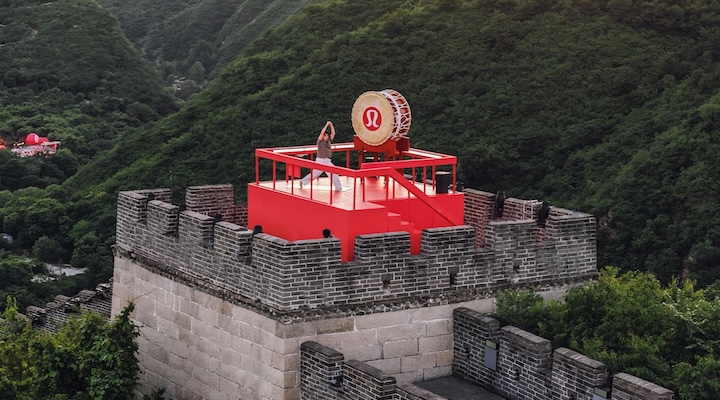
More than 2000 people unrolled their mats along the weathered stone of the Huanghuacheng Water Great Wall in Beijing’s Huairou district as part of Lululemon’s latest campaign to mark a decade in Mainland China. The yoga event was meant to read as a love letter to the market that has become the brand’s most reliable engine of growth. Within days, it became the latest case study in how fast a foreign brand can lose control of its own narrative in China. The unfortunate misstep Th
sp;
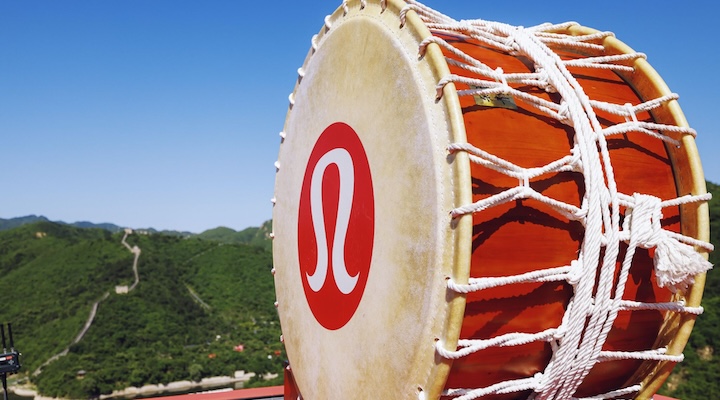
The trouble started when Chinese actor and brand ambassador Zhu Yilong, star of the film Lost in the Stars and the costume drama The Story of Ming Lan, joined the HiiKo drum troupe. His performance was meant to anchor the yoga festival, which the brand said was intended to promote a health concept and Chinese culture. But as footage spread across Weibo and Douyin, percussionist Xu Yang posted a video arguing that the large, double-sided instrument resembled a Japanese taiko, or wadaiko, rather than a traditional Chinese dagu. The two, he said, should never be confused.
Using such a drum to showcase Chinese culture at the Great Wall, he warned, would mislead the public and stir historical memories, according to his account cited by Sporting Goods Intelligence. By last Monday, the topic had drawn more than 50 million views on Weibo, with users demanding the brand apologise and rectify the campaign.
Lululemon later posted an apology on its official Weibo account. The company said the event had always upheld its original intention to pay tribute to Chinese culture, then conceded that “due to limitations in our professional knowledge, we were unable to fully identify potential controversies” and that it “ought to have planned and reviewed the percussion performance with more caution and thoroughness.”
It apologised to both Zhu and the public, pledged to “learn profound lessons,” and removed all related promotional content. The HiiKo troupe issued its own apology and pulled the instrument from its collection.
Why is it deeper than the drum?
Anti-Japanese sentiment runs deep in China, rooted in the atrocities of Japan’s wartime occupation and woven into the national narrative of the so-called century of humiliation. That sentiment has intensified under Xi Jinping’s brand of nationalism, particularly across the country’s heavily policed internet, where calls to boycott Japanese goods surface whenever old wounds reopen.
In addition, diplomatic relations between Beijing and Tokyo have soured since Japanese Prime Minister Sanae Takaichi’s remarks on Taiwan late last year, which gave Beijing ammunition for its claim that its neighbour was becoming more belligerent. A Japanese drum on the Great Wall, China’s most potent national symbol, was never going to read as a neutral aesthetic choice.
Yet the more revealing question may be why an event designed to celebrate Chinese culture unravelled so fast. According to Ada Yangyan Luo, executive director at OMD, the answer has less to do with the drum than with where it was struck. The irony, this analyst argues, is that Lululemon was following the very playbook luxury brands have embraced in China: after years of criticism for treating the country as just another market for global creative, many are now investing heavily in Chinese heritage, symbolism and cultural narrative.
“The Great Wall is not just a landmark. It carries historical meaning that changes how everything within it is interpreted. Once a brand enters that kind of space, the margin for error is categorically different. Most brands aren’t asking that question yet,” said Luo.
China has been Lululemon’s growth engine at a moment when its home markets have wobbled. Net revenues in Mainland China rose 29 per cent to US$1.8 billion in the year to the end of January, according to the Financial Times, and have more than quadrupled since 2021. In its most recent annual report, the company signalled it would keep investing in the market.
A familiar pattern
Lululemon is hardly alone in tripping over China’s cultural tripwires, and the most instructive recent parallel is Lemaire.
The brand drew a furious backlash over its “Objets Senteur” fragrance campaign. A braided linen diffuser named “Tresse”, styled in promotional images beside a pair of scissors and a long gown, was read by Chinese consumers as evoking the Qing-dynasty queue, the braided hairstyle imposed on Han men on pain of death and remembered as a symbol of subjugation.
Lemaire pulled the campaign and conceded it had “not sufficiently considered differences in perception and sensitivity across cultural contexts,” yet, many netizens dismissed the apology as a cover-up that implied they were merely oversensitive.
The pattern stretches back further. Last September, outdoor brand Arc’teryx triggered a government inquiry after a fireworks display in Tibet was criticised for its impact on a protected site, a spectacle that clashed with the brand’s conservation image.
Each case differs in detail, but the shape is the same: A campaign conceived elsewhere, approved without a local cultural read, and detonated by a public quick to notice what its authors did not.
Further reading: Behind Lemaire’s China misstep and what it costs.