Libertine Parfumerie’s new Melbourne flagship in Armadale, Melbourne, reads less like a traditional beauty counter and more like a manifesto for how niche fragrance retail is evolving: slower, more architectural and quietly data-informed. A flagship written into High Street For Libertine founder and CEO Nick Smart, Melbourne was never a question of if, but when – and precisely where. High Street in Armadale, one of the city’s most established luxury retail strips, became the obvious answer
answer.
“We’d been looking at Melbourne for a long time,” Smart told Inside Retail. “High Street in Armadale just felt right. There’s a real appreciation there for quality, design and considered retail; people take their time, they’re curious, and they value experience as much as product.” That cadence of browsing – lingering rather than rushing – matched a category that asks shoppers to pause, smell and compare.
The 140-square-metre boutique at 1023 High Street is calibrated for that mindset, positioned among fashion, gallery and lifestyle neighbours that already attract a clientele attuned to craft and design. Libertine had long served Victorian customers via e-commerce and distribution partnerships, but Smart waited for a tenancy that could sustain a flagship-level experience, not just a point of sale.
A layered interior as brand manifesto
The store extends Libertine’s long-running collaboration with Sydney-based interior designer Tamsin Johnson, who shaped earlier Libertine boutiques and returned to define what Smart calls a milestone and a manifesto for the brand. The brief was to translate Libertine’s evolution into an architectural expression – refined, immersive and “a little transportive”.
“Tamsin has been a long-term collaborator, so there’s already a shared understanding of the Libertine world,” Smart notes. “The brief is always about creating something that feels refined, immersive and a little transportive, somewhere that encourages people to slow down and explore.” Johnson answered with a space that unfolds as a sequence of intimate rooms rather than one open floor, guided by ceiling archways that create rhythm and pull visitors deeper into the store.
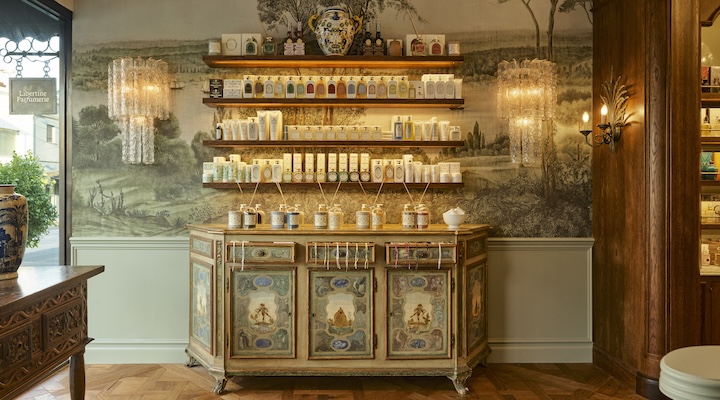
Parquetry flooring, dark timber joinery and references to classical European apothecaries anchor the boutique in the old world, while Murano glass lighting and vintage furnishings introduce softness and narrative. “I think it’s the layering of detail,” Smart says of the design’s impact. “From the parquet flooring and Murano-glass lighting through to the cabinetry and how the products are presented, everything is designed to feel cohesive and intentional.”
Johnson pushed the brand’s established palette further in Melbourne, adding wall niches, custom timber plinths and recessed banquette seating to create what she describes as more immersive, layered display moments. The cabinetry structure borrows from historic pharmacies, breaking up the long, narrow tenancy into functional zones without feeling repetitive, while a custom awning and brass signage tie the façade into Melbourne’s traditional high street vernacular.
Curation, pacing and the service choreography
Libertine’s merchandising strategy leans on its curatorial authority: a portfolio of more than 60 luxury perfume and lifestyle houses, from Creed and Trudon to Amouage, Matiere Premiere and Santa Maria Novella. Rather than crowd all of that into a single visual field, the store’s architecture enables each house to inhabit its own vignette.
“Curation has always been at the heart of what we do,” Smart said. “Every brand we bring in needs to have a strong point of view, whether that’s heritage, craftsmanship or a more avant-garde approach to perfumery.” In Armadale, that extends beyond fragrance to home scent, bath and body, and design objects – an ecosystem that pushes fragrance into daily ritual rather than occasional treat.
Pacing is central. “There’s also a sense of pace, it’s not overwhelming,” Smart explained. “You’re invited to move through the space, sit down, have a conversation and explore.” Large, timber consultation tables and recessed seating shift the dynamic from counter transaction to salon-style dialogue, giving staff room to conduct detailed profiling without the pressure of a queue forming behind a till.
This choreography responds to a customer base that has grown markedly more informed since Libertine’s founding in 2008. “The Australian niche fragrance customer today is almost unrecognisable compared with when we first started,” Smart observed. “Consumers are far more informed and engaged, often discovering new brands through social media and digital communities, which has also attracted a younger audience to the category.” Staff need to meet that sophistication with depth, not scripts.
Building expertise on the shop floor
In-store, Libertine’s competitive edge lies in expertise and education, which Smart has operationalised through hiring and training rather than just marketing copy. “For us, it always starts with people who are genuinely curious and passionate about fragrance,” he said. “You can teach knowledge, but that instinct to engage and connect with customers is key.”
Training is treated as a continual process. The Armadale team spends time on brand storytelling, raw materials and composition, but also on reading non-verbal cues to avoid overwhelming guests with information. “The goal isn’t to present everything at once, it’s to edit and guide,” Smart added. “It should feel like a conversation, not a lesson.” This approach mirrors the store design: Both aim to edit the global niche landscape into a navigable journey.
A dedicated masterclass and private consultation space extends that journey into structured experiences. Group masterclasses might explore a single raw material or a brand universe, while more intimate bridal and bespoke sessions focus on building a personal scent wardrobe over time. “Education has always been central to Libertine, but it has to feel engaging and enjoyable,” Smart said. “Guests are smelling, asking questions. It’s interactive.”
These events function as both brand-building and commercial levers, deepening loyalty in a category where repeat purchases can span years. With a regular cadence of masterclasses, brand-led activations and tailored appointments, Smart’s ambition is to help curious visitors evolve into long-term clients embedded in a fragrance community anchored in Armadale.
Tech, data and a quiet loyalty strategy
Behind the Old-World materiality sits a modern tech stack designed less to be a spectacle on the shop floor than to record preferences quietly and power long-term relationships. At launch, Libertine is inviting guests to join its database in exchange for a complimentary fragrance sample, a tactic that creates an immediate bridge between in-store discovery and at-home trial.
“It’s really about enhancing the experience, not interrupting it,” Smart said of the brand’s digital tools. “The idea is to build a profile of what a customer likes over time, the notes they gravitate towards and the brands they’ve explored, so we can make more thoughtful recommendations.” Each interaction, whether at the consultation table or via e-commerce, becomes a data point that can inform more precise curation – what invitations to send, which new launches to highlight, which samples to include.
The sample-for-data exchange is a deliberate entry point: Customers leave with something tangible, while Libertine gains permission to continue the conversation through personalised communication rather than generic promotions. “From there, it’s about staying connected in a way that feels relevant and personal, rather than overly transactional,” Smart noted. The loyalty strategy is less points-and-rewards, more continuous, high-touch storytelling supported by digital infrastructure.
Omnichannel as a single fragrance ecosystem
Libertine’s physical expansion sits on top of a mature wholesale and e-commerce operation that already spans department stores, specialty retailers, travel retail and a comprehensive online boutique. Smart describes the brand’s universe as a single ecosystem, with Armadale acting as both destination and node within that network.
“For us, it’s all one ecosystem,” he said. “A customer might discover a brand online, come in-store to experience it properly, then reorder digitally – or the other way around. The key is consistency.” That consistency extends from the way brands are introduced and categorised online to the tone of editorial content and virtual education.
Online masterclasses emerged as a way to bridge physical and digital, offering the same education-led approach to customers who cannot attend in person and feeding demand back into both channels. As Libertine grows its 13-boutique network nationwide, this omnichannel design allows flagship locations like Armadale to function as high-impact touchpoints without having to carry the full weight of distribution.
Future expansion will remain measured. “Growth for us has never been about scale for the sake of it. It’s about finding the right opportunities,” Smart concluded. “There’s definitely more to explore in terms of flagship experiences and deepening our relationships with brands, as well as continuing to evolve categories around home and lifestyle. But at the core, it remains the same – curation, education and creating meaningful experiences around scent.”
Further reading: Why luxury Aussie fragrance house Goldfield & Banks champions local botanicals