Yum China has proven a case study in how difficult it is for operators to consistently grow global brands in one of the world’s most competitive consumer markets. While retail brands constantly face sluggish discretionary spending and relentless local competition, Yum China appears to have turned a corner. The operator of KFC and Pizza Hut in China reported a fourth quarter that capped a year of steady operational recovery. System sales rose 7 per cent year-on-year in the December
ember quarter, same-store sales grew 3 per cent, the third consecutive quarter of positive growth, and operating profit surged 25 per cent to US$187 million.
For the full year, operating profit climbed 11 per cent to US$1.3 billion, while diluted earnings per share rose 8 per cent, or 14 per cent when stripping out mark-to-market and foreign exchange effects.
Growth without exuberance
The company’s full-year system sales rose 4 per cent, while same-store sales edged up 1 per cent. Revenue grew at a similar pace, reaching US$11.8 billion this year.
Same-store transactions increased for 12 consecutive quarters. In the fourth quarter, transaction growth of 4 per cent more than offset a broadly flat ticket.
Across both KFC and Pizza Hut, value-for-money offerings, smaller order sizes and sharper pricing have taken priority over margin-expanding premiumisation. Pizza Hut’s average ticket sales declined 11 per cent year-on-year in the fourth quarter, even as same-store transactions jumped 13 per cent and operating profit rose 52 per cent to a quarterly record.
KFC anchors the model, Pizza Hut narrows the gap
KFC, remaining the backbone of Yum China’s earnings power, generated US$1.3 billion in operating profit last year, up 8 per cent year-on-year, with operating margin expanding to 14.5 per cent. System sales rose 5 per cent for the year, supported by steady traffic growth and continued store expansion.
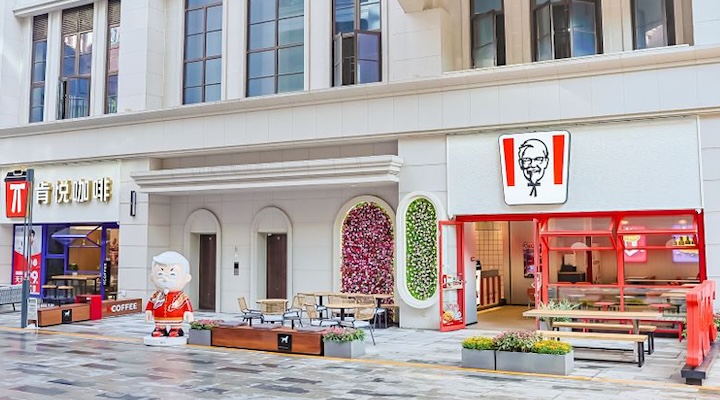
The brand has been focusing on widening consumption occasions rather than reinventing the core. Side-by-side formats such as KCoffee cafés and KPro modules have helped increase frequency, while delivery accounted for 48 per cent of KFC’s company sales for the year.
Pizza Hut, long viewed as Yum China’s weaker asset, delivered a quieter but arguably more important turnaround. Full-year operating profit rose 19 per cent to US$183 million, while operating margin hit a record 7.9 per cent, the highest since Yum China’s 2016 listing. Store-level margins improved even as the brand pushed aggressively into lower-tier cities with simplified formats and tighter menus.
Meanwhile, Lavazza opened 34 net new stores, including its first store in Hong Kong, taking its total store count to 146. Same-store sales growth turned positive last year, and overall store economics improved meaningfully.
Expansion shifts inland and toward franchising
The company opened 1706 net new stores last year, bringing its total footprint to 18,101 locations. More than 30 per cent of new stores were franchised, up from historical levels.
Growth is increasingly coming from lower-tier cities, where capital requirements are lower and competitive intensity, while rising, remains more manageable. KFC now operates in more than 2500 cities, while Pizza Hut is present in more than 1000.
The company targets more than 20,000 stores this year and more than 30,000 by 2030, with a 40–50 per cent franchise mix for new openings.
“We see great potential for growth in China,” Joey Wat, CEO and executive director at Yum China, said during the earnings call. “I visited Chongqing, China’s largest city by population, with more than 30 million people. In this widespread market, I saw a strong appetite for affordable, good food. KFC’s density is only four stores per million people, well below the average of 17 in Tier 1 and 2 cities or Shanghai’s 28.”
Digital scale as a competitive moat
Yum China’s digital ecosystem has quietly become one of its most valuable assets. By the end of last year, total membership across KFC and Pizza Hut exceeded 590 million, with 265 million active users. Digital ordering accounted for 94 per cent of total sales, while digital sales reached US$10.4 billion, up 8 per cent year-on-year.
The China factor
Management was notably cautious when discussing the broader Chinese consumption backdrop. While executives acknowledged early signs of stabilising sentiment, they stopped short of framing 2025 as a demand rebound story.
Small shifts in consumer behaviour have an outsized impact on labour, supply chains and store-level economics. As management put it, the task is no longer to “ride” demand cycles, but to engineer systems that can absorb volatility without sacrificing profitability.
Chinese New Year crystallises that challenge.
“Chinese New Year falls on February 17, considerably later than in most years,” Wat said.
“Our teams have prepared comprehensive scenario plans by the week and even daily. People will soon be travelling and gathering for the holiday season. Our brands are focusing on their signature products to capture the heavy traffic during Chinese New Year, while maintaining strong operational efficiency.”
Further reading: Why Yum China believes its fastest growth is still ahead.