When Sweden’s ReTuna Återbruksgalleria opened its doors in the industrial city of Eskilstuna in 2015, few could imagine that a mall dedicated entirely to second-hand goods would become a global symbol of circular consumption. Ten years on, the “second-hand only” shopping mall remains a living experiment in how cities can transform waste into value – and consumers are embracing it. A municipal experiment in circular consumption ReTuna was not born out of commercial ambition, but from a m
om a municipal vision. As part of Eskilstuna’s ambitious climate and waste reduction strategy, the local government established the mall beside the city’s main recycling centre. This design decision was deliberate — the recycling centre handles household waste, while the mall transforms reusable materials into desirable products.
At the heart of ReTuna’s operation is Returen, or “The Return,” a drop-off depot where locals donate unwanted items – from clothes and furniture to electronics, toys and homewares. Each item is first assessed by staff from AMA, the municipality’s resource unit for rehabilitation and employment. Usable goods are passed on to the mall’s shop owners, who repair, upcycle or refurbish them before placing them back on display. Nothing is wasted; everything is reconsidered.
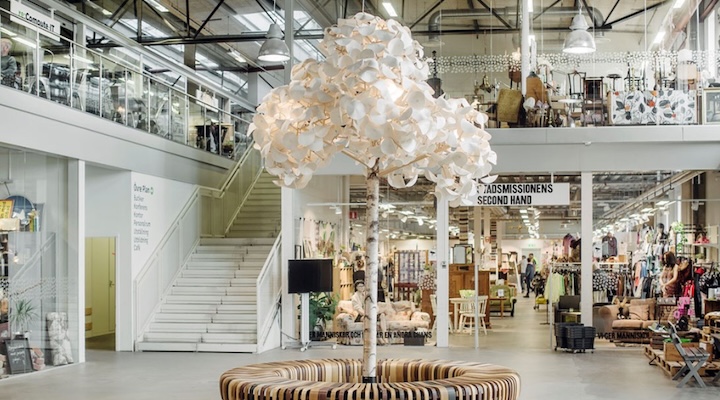
This process turns what would have become landfill into new products, creating a continuous material loop. The model challenges the idea that sustainable shopping must be inconvenient or niche. Instead, ReTuna’s bright displays, clean layouts and well-curated shops make it feel like any contemporary Scandinavian retail destination – only here, everything comes with a story.
Economic success from discarded goods
The results have been impressive. In 2018 alone, ReTuna generated SEK 11.7 million in sales (around AU$1.6 million at the time) from recycled products. The mall has also created more than 50 jobs, supporting both local employment and skill-building in upcycling and retail.
Beyond its financial impact, ReTuna represents a deeper economic shift toward circularity – a system that retains the value of materials for as long as possible. According to a 2024 report by Transparency Market Research, the global second-hand products market is expected to surpass US$1 trillion by 2035, growing at a staggering 17.2 per cent annually. ReTuna’s success reveals how local initiative and structural support can harness this momentum on a city scale.
However, this innovation relies on more than consumer enthusiasm. The mall’s continued viability depends on public funding and government backing, underscoring that truly circular systems often require institutional commitment as much as individual participation. As one local retailer put it, “ReTuna works because it’s infrastructure – not just ideology.”
Redefining what second-hand means
Visitors to the mall have described the experience as “accessible”, “curated” and “convenient.” This is no chaotic jumble of mismatched odds and ends. Each store maintains its own identity – from vintage clothing and refurbished tech to sustainable interiors – with a level of polish that rivals new retail. The design philosophy is subtle but powerful: make sustainability feel aspirational.
In doing so, ReTuna changes not only what and how people buy, but how they think about consumption itself. Rather than framing reuse as sacrifice, the mall frames it as innovation. That mindset – turning old into new – is what makes ReTuna a cultural experiment as much as an economic one.
Australia’s growing second-hand movement
While Australia doesn’t yet have a dedicated second-hand shopping mall, its circular fashion and resale scene is thriving. Over the past decade, businesses like SWOP, Goodbyes and Hunter Markets have led the way in redefining what “pre-loved” looks like.
SWOP, founded in Brisbane and now with stores in Sydney and online, offers a carefully curated range of vintage and designer fashion. Its stores operate on a trade-in model: customers exchange clothing for cash or store credit, a system that encourages circular consumer habits without requiring municipal infrastructure.
Similarly, Goodbyes, with locations in Melbourne’s Brunswick, Collingwood and Prahran, has built a reputation for quality second-hand fashion, from local labels to international designers. The company’s goal is as aesthetic as it is ethical – to make reuse stylish and sustainable living mainstream.
Meanwhile, Melbourne’s Hunter Markets have become a social phenomenon, drawing weekend crowds to Mentone’s vibrant purple warehouse for influencer wardrobes, retro finds, and on-trend bargains. These markets tap into the same impulse driving ReTuna: the desire for conscious shopping that feels both personal and contemporary.
A blueprint for the future
ReTuna’s decade-long success story raises a question worth considering far beyond Sweden: what if every city had its own circular shopping hub? The Swedish model shows that with the proper infrastructure, government backing, and public participation, it’s possible to turn waste into an engine of community renewal and sustainable growth.
Australia’s thriving resale ecosystem hints at fertile ground for such innovation. As the appetite for sustainable consumption grows, the next step may be to integrate local circular retail with municipal systems – closing the loop, just as Eskilstuna did.