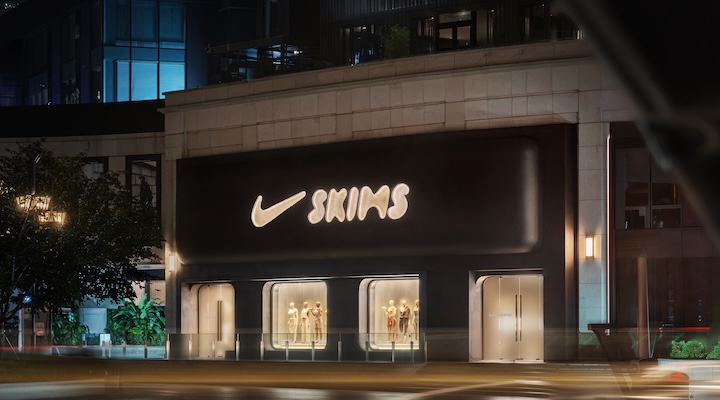
Before the NikeSkims store had even opened, a queue had formed outside a street-facing unit at Shanghai’s HKRI Taikoo Hui, across the road from the ship-shaped Louis Vuitton flagship. By midday, staff were telling shoppers the wait to enter was more than an hour. The fitting rooms had their own ticketed queue. The unit, formerly home to an IWC Schaffhausen boutique, is now NikeSkims’ first physical store in China. Kim Kardashian, her mother Kris Jenner and sister Khloé Kardashian attended t
nded the launch the previous evening, alongside Chinese athletes and performers including basketball player Li Meng and singer Lexie Liu.
The spectacle matters. So does what is happening behind it.
A controlled China launch
NikeSkims announced its China entry in early September and opened the Shanghai space to the public last week, just ahead of China’s seven-day National Day holiday.
The site runs until February 2027 and will be the brand’s longest-running pop-up to date. It stocks the Fall 2026 Edit 01 collection: Nine apparel fabric families, footwear including the split-toe Rift, and accessories. Tailoring is available on selected pieces, and the space is built around fitting rooms, lounge areas and personalised services.The China campaign is fronted by athletes including Hong Kong swimmer Stephanie Au, Dutch speed skater Jutta Leerdam, snowboarder Chloe Kim and hurdler Anna Cockrell.
NikeSkims has so far moved cautiously through Asia. Its earlier launches in South Korea, Singapore and Japan were built around pop-ups, Nike-owned stores and multi-brand retailers. None resulted in a permanent standalone store.
NikeSkims is testing demand without committing to a full store network. That restraint may be particularly important given the state of Nike’s core business in the market.
A new brand in a difficult market
Two days after the NikeSkims launch, Nike reported its first-quarter results for fiscal 2027. Greater China revenue fell 22 per cent to US$1.18 billion, or 26 per cent on a currency-neutral basis, marking the region’s ninth consecutive quarter of decline.
Nike is simultaneously trying to regain control of how its products are sold online. The company is consolidating digital sales around its own app and official flagship stores on Tmall, JD.com and Douyin, with the stated aim of reducing discounting and creating a more consistent full-price proposition.
Chief executive Elliott Hill told analysts that cleaning up Nike’s digital distribution in China would take “multiple seasons”.
NikeSkims enters China already inside that model. It has no distributor e-commerce to unwind, no third-party web stores pricing it below retail, and one price set by Nike. If Nike wants to show investors and its wholesale partners that full-price selling still works in China, a new brand with no discount history in the market is the cleanest place to try.
The women’s opportunity
The opportunity is particularly interesting because Nike’s position in women’s apparel in Greater China is relatively small compared with the size of the market.
Nike’s Greater China apparel revenue across men’s and women’s categories, including Hong Kong, Macau and Taiwan, was US$279 million in the quarter to 31 August.
Lululemon’s Mainland China revenue in its quarter to 2 August was US$407.1 million. On those figures, Lululemon’s Mainland business sold about 46 per cent more than all of Nike’s apparel across Greater China.
Greater China accounted for about 10.5 per cent of Nike Inc’s revenue in the latest quarter, down from about 12.6 per cent across fiscal 2026. Nike cut demand creation spending in Greater China by 11 per cent to $88 million in the quarter.
NikeSkims therefore arrives at a particularly consequential moment for premium women’s activewear in China.
The category benchmark of the past decade, Lululemon, is itself showing signs of strain. Mainland China revenue rose 4 per cent in the second quarter, but fell 2 per cent at constant currency, while comparable sales declined 8 per cent. Management described the result as well below expectations, citing negative brand sentiment and a weaker 618 shopping festival, and lowered its full-year China growth expectation to the high single digits.
At the same time, competition is multiplying.
Alo opened its Tmall flagship and WeChat mini-program in August with actress Zhao Lusi, reported that more than 8000 pairs of its 1150-yuan trousers sold by 8pm on launch day. Maia Active, the Shanghai-founded brand in which Anta Sports holds a 75 per cent stake, sells on fit developed for Asian bodies and is targeting 60 to 70 stores by the end of 2026.
Sweaty Betty opened a concept pop-up at Jing’an Kerry Centre in April, and Vuori is stepping up its China push.
Euromonitor estimated China’s women’s sportswear market passed 120 billion yuan last year.
Is NikeSkims a growth engine, or a test?
That makes the Shanghai store more interesting than its queue might suggest.
The immediate temptation is to read the turnout as proof that NikeSkims has found a formula for China. But a Kardashian-led opening, a national holiday and a highly controlled pop-up can generate enormous attention without necessarily translating into repeat purchases or a scalable retail business.
The more significant opportunity is what Nike can learn from the experiment.
Further reading: Experts weigh in on NikeSkims’ chances for success in a hyper-saturated market.