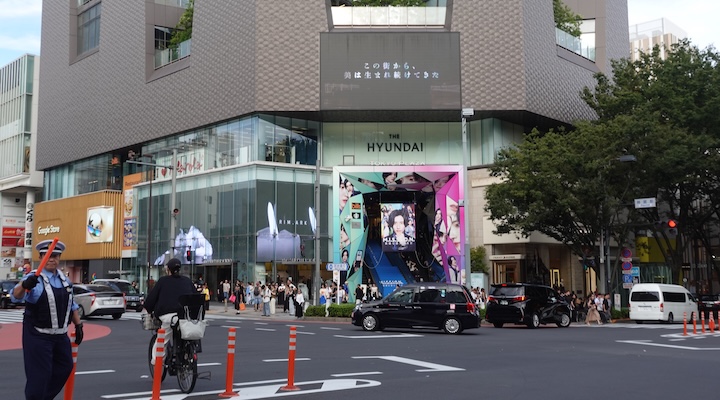
Picture two Saturday afternoons in Tokyo’s busiest shopping district, Shibuya, one year apart. On the first, in August 2025, much of the chatter would have been in Mandarin, after Mainland China sent more than 1 million visitors to Japan that month. On the second, this August, the same streets would sound very different, with most shoppers hailing from South Korea, Taiwan and Hong Kong. The shift reflects a striking change in the country’s visitor numbers. This year, arrivals from main
m mainland China fell nearly 60 per cent to just 418,000 this August. Yet the country largely made up the shortfall elsewhere, with overall tourist numbers dropping by less than 10 per cent and still hovering over a healthy 3 million.
What happened?
The collapse started last November when Prime Minister Sanae Takaichi told parliament that a Chinese attack on Taiwan could amount to a “survival-threatening situation” for Japan. Within days, Beijing urged its citizens not to travel to Japan as an attempt to punish Takaichi’s government economically.
Airlines quickly fell into line. Chinese carriers offered free refunds and changes on Japan tickets, and Beijing asked airlines to reduce flights to Japan through March 2026, Bloomberg reported at the time.
Aviation data from OAG, cited by the South China Morning Post, showed 2641 round-trip flights scheduled between China and Japan for August 2026, against 6127 a year earlier. Air China, China Eastern and China Southern have extended their free refund and change policies on Japan travel to 24 October.
Tokyo has added costs of its own. From July 1, Japan’s international tourist tax tripled to 3000 yen per departing traveller. Visa fees rose fivefold on the same date, the first increase since 1978. The visa increase does not apply to visa-exempt markets such as South Korea, Taiwan, Hong Kong, the US and Australia. It falls squarely on visa-required markets, and Japan requires every Mainland Chinese visitor to hold a visa regardless of length of stay.
Beijing responded. On September 11, the Chinese Embassy in Tokyo announced that from September 14, the single-entry visa fee for Japanese nationals would rise to about seven times the previous level. Foreign Ministry spokesperson Mao Ning said the change was made in accordance with the principle of reciprocity.
Who filled the seats?
Japan has been remarkably effective at replacing the lost headcount.
Over the first eight months, South Koreans made 7.42 million visits, up 21.2 per cent and more than two and a half times China’s total. The country now accounts for about 27 per cent of all arrivals this year, up from about 22 per cent over the same period of 2025.
Taiwan is the second pillar. Arrivals rose 19.8 per cent to 5.4 million between January and August, which also puts Taiwan ahead of Mainland China. Hong Kong added 8.7 per cent to reach 1.82 million. Together, Korea, Taiwan and Hong Kong supplied roughly 53 per cent of Japan’s visitors this year, against about 43 per cent a year ago.
The US remains the largest long-haul market, with 2.31 million arrivals year to date, up 6.1 per cent. Beyond the big four, several smaller cohorts are growing much faster than the market. Year to date, arrivals from Mexico rose 28 per cent, Russia 22.1 per cent, India 20.2 per cent, the Middle East 16.3 per cent, Malaysia 15.9 per cent and the Nordic countries 13.4 per cent. Indonesia, Spain and Singapore each grew by 10 per cent or more.
Replacing visitors is easier than replacing spending
Even though the loss of Mainland Chinese tourists was quickly made up, there is no certainty that the new wave of tourists sustain the spending that has made inbound shopping such a powerful engine for retailers.
The Japan Tourism Agency said international visitors spent 2.5 trillion yen in the second quarter, up 0.2 per cent year on year, while spending per visitor reached a quarterly record of 244,457 yen.
The mix underneath has changed sharply. US visitors were the biggest spenders, at 384.8 billion yen, followed by Taiwan at 363.9 billion yen. China fell to third with 259.2 billion yen, down 48.8 per cent year on year. South Korea was fourth with 258.9 billion yen, and Hong Kong fifth with 145.2 billion yen.
That leaves South Korea, now Japan’s biggest source of visitors by a wide margin, spending about the same in total as China, even though Koreans made two and a half times as many trips to Japan in the first eight months of the year.
Taiwan and the US have become increasingly important to Japan’s inbound spending mix. Whether the new arrivals shop the way the old crowds did is a different matter, and the answer varies sharply by retail channel.
The department-store paradox
Against that backdrop, Japan’s department-store figures look almost counterintuitive.
Nationwide department-store sales rose 2.3 per cent in June, according to the Japan Department Stores Association, extending the industry’s run of year-on-year growth. Inbound duty-free sales jumped 29.8 per cent to 50.9 billion yen. Yet the number of foreign customers making purchases fell 0.5 per cent, the eighth consecutive monthly decline. That run began in November 2025, the month of Beijing’s travel warning.
So far, the clearest beneficiaries have been retailers with strong luxury and flagship exposure.
Isetan Mitsukoshi Holdings reported operating profit rose 20.6 per cent to 18.9 billion yen and net profit rose 18.5 per cent to 22.3 billion for the second quarter. Overseas-customer sales at its domestic department stores reached 33.6 billion yen, up 19.8 per cent, and its registered overseas-customer base grew to 1.08 million by the end of June. The strength is concentrated in its Tokyo flagships, Isetan Shinjuku and Mitsukoshi Nihombashi, where affluent domestic customers overlap with high-spending international visitors.
Not every retailer has the same insulation. H2O Retailing, which operates the Hankyu and Hanshin department stores in Kansai, was particularly exposed to the drop in Chinese travel. Osaka and Kansai International Airport routes were among those Chinese carriers cut. Matsuya’s Ginza and Asakusa stores still reported declines in early this year, even as larger rivals returned to growth. Meanwhile, J. Front Retailing’s department-store inbound business saw visitor numbers rise while spending per customer fell sharply in the first half of its fiscal year.
The pressure is potentially greater for drugstores, discount chains and electronics retailers, whose inbound business has historically depended on high-volume purchases of cosmetics, over-the-counter medicines and appliances, the categories most closely tied to Chinese group tours.
Pan Pacific International Holdings, operator of Don Quijote, remains exposed to inbound traffic through its dense network of tourist-oriented stores, although its wider domestic business has continued to grow. Comparable domestic retail sales rose 2.6 per cent in the first two months of its new fiscal year, with spending per customer also increasing. MatsukiyoCocokara sits in a category that has historically benefited from inbound demand, but its broader business is less dependent on foreign visitors than the classic department-store model.
How retailers are adapting
Department-store operators are, overall, more optimistic than the arrival numbers suggest. In a Nikkei survey of 49 department-store companies, reported by Nikkei Asia, 38.8 per cent said they expect inbound sales to rise in fiscal 2026. On visitor numbers, 34.7 per cent expected an increase, 8.2 per cent forecast a decline and 22.4 per cent expected no change.
That optimism follows a difficult year. In the same survey, 36.7 per cent said inbound visitors fell in fiscal 2025, slightly more than the 34.7 per cent that reported an increase, and 42.9 per cent reported lower inbound sales. Respondents pointed to the weak yen and to growth from Southeast Asia, the US and Europe as the reasons for the better outlook.
The larger groups are now treating inbound shoppers as customers to be retained.
Isetan Mitsukoshi says 71 per cent of its overseas customers have downloaded its app, which it uses to bring them back on their next trip to Japan. Chief financial officer Yoshinori Makino told Nikkei Asia that the company will start linking customers’ passport information to their app accounts in the second half of fiscal 2026, allowing it to communicate with them based on their shopping history.
Takashimaya set up a dedicated inbound business office in March and plans to use customer data from its own stores in Singapore and Vietnam to run promotions that steer those shoppers to its Japanese stores. J. Front Retailing is working with Thailand’s Central Group on mutual customer referrals.
The shift is forcing Japanese retailers to rethink what an inbound customer is worth.
For years, the Chinese tourist was central to Japan’s inbound retail model. That model is now being tested. The replacement is not one new market, but a more fragmented mix of countries with different shopping habits. That makes localisation more important for retailers but it also makes the business less dependent on any single nationality.