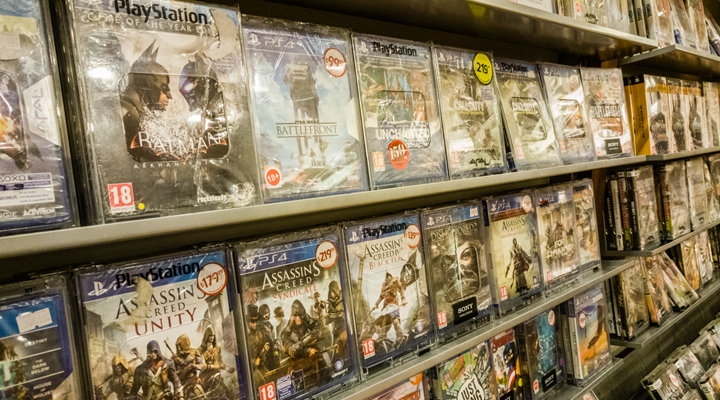
Last week, Sony announced it would stop producing Playstation game discs from January 2028, with all distribution shifting to digital downloads. On the surface, the decision seemed a long-overdue reaction to changing consumer trends. Around 80 per cent of Playstation games are already bought digitally, making physical discs increasingly expensive to manufacture, distribute and stock. But to its critics, the announcement represents an audacious attack on competition. “This is all about co
control,” analyst Rhyss Elliot told industry bible Eurogamer. “Everything Sony gains from killing the disc flows from the fact that a disc is a unit of value the platform holder stops earning from the moment it’s first sold. A disc can be resold or rented a hundred times, and Sony sees revenue from those transactions.”
Industry dominance
It’s not just a case of second-hand sales. What separates computer games from music and film is that Sony has a near monopoly on the high-end home console market. Whereas discs can be purchased from a variety of retailers, Sony has total control over downloads onto its system. As Dr Ryan Stanton, a lecturer in the UNSW School of Social Sciences, argued, “It consolidates consumer choice by eliminating the alternative, even if that alternative had become niche. The continued success of companies producing physical editions of digital-first games shows there’s still a dedicated audience that Sony is choosing to leave behind.” And while boxed sales could theoretically continue via a ‘download code’ printed and placed in a case, it seems like a pointless stay of execution as well as a waste of plastic.
“Consoles are already relatively walled gardens, but by making the purchase of games all but exclusive to a transaction on the platform itself, Sony is essentially achieving peak vertical integration, the wettest of corporate dreams,” argued Eurogamer editor Chris Tapsell. “Walled gardens typically mean a couple of things: nice, smooth processes for buying and downloading stuff, at the cost of worse deals for developers, higher prices, and reduced consumer rights for those who do the buying. You need only look at console platforms themselves for a taste of it, with the rent-seeking practice of demanding a continuous – and not cheap – subscription to access relatively basic features of modern gaming such as cloud saves or online multiplayer.”
For Australian retailers, however, the commercial consequences may prove more muted. Gaming was once an important traffic driver for chains such as JB Hi-Fi, but today the business has become far more weighted towards consoles and broader consumer electronics and entertainment hardware. Software, including music, DVDs and video games, accounted for just 8 per cent of JB Hi-Fi’s total sales in 2020, a number down from 27 per cent a decade earlier. More tellingly, the retailer’s FY2025 performance was bolstered by demand for gaming hardware following the launch of Nintendo Switch 2.
Independent gaming retailer The Gamesmen spent more than 40 years creating a business built on pre-owned games, collectables, community events and specialist expertise. Owners Daniel and Chris Cusumano grew up working during school holidays and helping their parents build their business. Today, its Penshurst store in southern Sydney houses a gaming museum that showcases more than 45 years of gaming history. That community priority appears central to the business, as Chris Cusumano said in an interview with eBay, “We listen to feedback, we listen to customers… We’ve made changes off one review because we agree, and we want to make it a better place. I think the customers just keep coming back.” Ironically, The Gamesmen’s devotion to the physical side of gaming may be exactly what helps it weather a digital-only future.
Who owns a digital game?
The ramifications of Sony’s decision also extend beyond commercial retail into the complex question of ownership itself. In essence, you don’t truly own a game you download in the traditional sense, but simply acquire a long-term licence to play it. A right that can be revoked if the platform holder stops supporting it via updates or ‘patches’ it needs to run smoothly. “Preservation is already one of gaming’s biggest challenges,” said Stanton, whose research found that around 40 per cent of games that have had online features shut down over the past decade are now entirely unplayable.
The distinction has become more consequential as major releases sell for between $110 and $125 in Australia, while consumers receive fewer of the traditional rights associated with physical ownership. Australian regulators have already tested the legal boundaries of digital game sales and have ensured that overseas marketplaces remain subject to consumer law. In 2016, the Federal Court found that Valve Corporation had breached the Australian Consumer Law by misleading customers about their refund rights for digitally downloaded games, resulting in a $3 million fine.
Consequences for regional Australians
Sony’s announcement finally reveals where much of the market has already travelled; it reveals unprecedented influence in the hands of platform owners. As Elliot put it, “vinyl, film, and print are all enjoying an analogue revival right now. Games, a younger medium, are sprinting the other way, because unlike a record label, a platform holder owns the storefront and captures far more by closing the disc than by keeping it.”
Digital transition will inevitably affect retailers that rely solely on selling physical games, although businesses such as The Gamesmen have survived for four decades by leveraging the enduring allure of collectable gaming culture. As shelves gradually surrender plastic cases for download codes, that philosophy may become the industry’s most durable asset, proof that while technology evolves with remarkable speed, trust, expertise and community remain considerably harder to replicate.
Further reading: Apple’s warning: How the chip crunch is about to impact retail prices