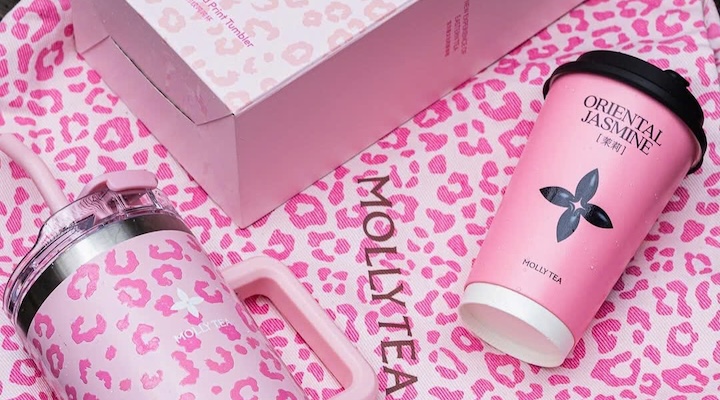
Chinese milk tea chain Molly Tea has been ordered to pay 10.3 million yuan (US$1.5 million) to Louis Vuitton for infringing its four-petal flower trademark. The defendants were also ordered to publish corrective statements across Molly Tea’s website, Weibo, WeChat, Xiaohongshu and Douyin accounts. The company later said it will appeal to a higher court. The logic behind the lawsuit Many have questioned why a French luxury house would sue a Chinese milk tea chain over a trademark when the
when there is no direct competition between the two brands.
Under Article 13 of the Trademark Law, well-known registered trademarks enjoy cross-class protection: a mark famous enough that its use on unrelated goods would mislead the public into assuming an association can be enforced beyond its original product categories.
You Yunting, a partner at DeBund Law Offices, told Yicai Global that Louis Vuitton’s four-petal floral motif has a high level of recognition and distinctiveness, and clearly should have been avoided by the defendant.
“Louis Vuitton holds seven Chinese registrations for its specific rendering, recognised and distinctive after decades of use,” said Mike Limat, a China-based trademark consultant. “The court compared that rendering to Molly Tea’s, found them highly similar, and noted that Molly Tea had filed 17 of its own four-petal applications since 2022. All of those applications were refused or invalidated for conflicting with Louis Vuitton’s prior rights.
“The warning signs were already on the register. Molly Tea’s own applications for the flower device had already been refused or invalidated before this judgment was handed down. Proceeding to build 2000-plus stores on a sign the register kept rejecting based on prior rights is what turned an ornament into an infringement.”
The court of public opinion
The hashtag ‘LV sues Molly Tea, awarded 10.3 million yuan’ topped Sina Weibo’s trending list within a day, drawing some 350 million views. The reaction split along revealing lines.
One camp sided with the court, arguing that a brand which kept using a floral device after its own registration attempts failed could hardly plead coincidence and that plenty of commenters, seeing the emblem cold, thought of Louis Vuitton first and jasmine tea second. Meanwhile, another camp dismissed the resemblance outright, insisting a takeaway tea counter and a Parisian leather-goods house share no customers, no shelf space and no plausible risk of confusion.
The loudest strand, though, turned the accusation around. Netizens traced four-petal floral motifs to traditional Chinese ornament, including the baoxiang flower patterns of the Tang Dynasty (618–907), and accused the maison of monopolising designs with Chinese roots – cultural appropriation, in effect, with a registration certificate attached.
Legal commentators quoted in Chinese media pushed back, noting that trademark law protects existing registered rights rather than relitigating a motif’s historical inspirations, and that heritage patterns and brand protection can coexist so long as new executions are sufficiently differentiated.
“Anyone can use a thousand-year-old flower,” as Limat puts it. “What you cannot do is use someone else’s registered version of it on a hundred million cups.”
Lessons on both sides of the courtroom
Chinese courts are willing to hand foreign luxury houses substantial awards against domestic defendants, yet Limat sees a flip side for foreign rights holders.
“Enforcement in China can collide with cultural sentiment, and the backlash arrives fast. Winning in court while being cast as the foreign brand attacking Chinese heritage is only half a win,” he said, pointing to Lululemon’s Great Wall yoga event last month, where a drum performance meant to honour Chinese culture was identified by netizens as Japanese taiko. “The lesson stands: in China, reading the culture is not the soft part of brand strategy. It is the strategy.”
Meanwhile, the lesson for Chinese brands cuts the other way.
Founded in Shenzhen in 2021, Molly Tea specialises in fresh milk tea with floral notes and has rapidly expanded to more than 2000 stores in China and more than 50 overseas locations, including the US, Canada, Australia and Southeast Asia.
The brand is riding the same new-tea wave that carried Chagee and Mixue to public listings. Brands of that scale can no longer treat visual identity as a growth hack.
“When your core visual identity can’t get registered, you might want to rethink your brand strategy,” Limat said. “The costs of rebranding over 2000 stores and building up years of goodwill make early clearance and a proper assessment look like a bargain.”
The appeal, which Molly Tea has 15 days from receipt of the written judgment to file, will now run its course as China’s pending Trademark Law amendments prepare to further expand well-known mark protection.
“The appeal will test whether that line holds,” Limat said. “Let’s wait and see how Molly Tea will approach this matter in their overseas markets.”