The Asian market offers the perfect environment for retailers to test new ideas, adapt to the local culture, respond to new trends, and ultimately pursue long-term growth.
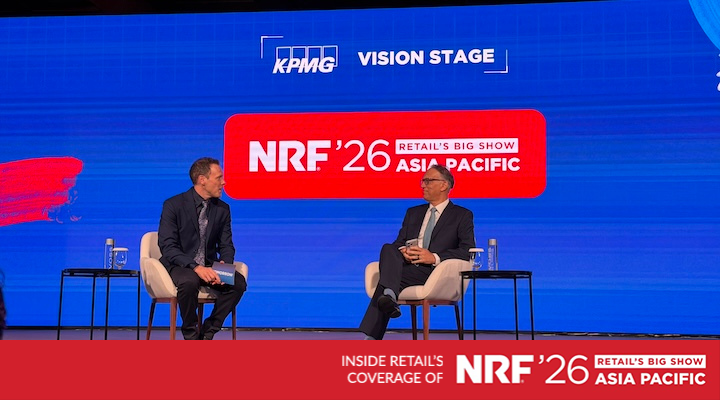
Vipul Chawla, group CEO of Singapore’s FairPrice Group, opened day two of the NRF 2026 Asia Pacific on Wednesday by describing Asia as the “retail lab of the world”, with retailers inventing “the next now” as part of their growth strategy.
“For years, Asian businesses would travel to the western part of the world and try to learn what was happening there, hoping to be the first to bring it back into their markets.
“But something has started to change, and that change is not just gradual, it is continuous. In Asia, we don’t just adopt or adapt, we innovate, and increasingly, when we do all of that, we start to construct,” Chawla said.
As the competitive advantage is becoming increasingly harder to sustain in the current pace of change, failing to adapt would mean moving backwards, he added.
Adapting to stay relevant
During a session on experience-led retail, Carmen Chiu, director of branded products at Hong Kong-based Maxim’s Group, further emphasised the importance of adapting brands to local markets as she shared her previous experience working at brands such as Ferrero, Godiva and Fortnum & Mason in the region.
According to Chiu, brands can do this by identifying the markets and the role they want to play, taking out what’s relevant to those markets, and promoting their products.
“You can’t just take the brand and copy-paste it from its original market. Yes, you have to stay true to the brand, but there’s still that small proportion that you need to adapt it to make it properly relevant. Otherwise, consumers will never feel connected with the brand and won’t go after it,” she said.
Chiu listed an example at Godiva, which faced challenges like a low consumption per capita rate in the region. Asian customers, unlike their European peers who consume more chocolate on a regular basis, mainly bought the brand’s products during special occasions like Christmas, Chinese New Year and Valentine’s Day.
“Godiva was quite unapproachable in a way, because you need a certain income and a certain appreciation before you can afford it. A lot of customers were kind of ruled out because they didn’t feel they could to walk into the stores. So we asked ourselves: what can be the other occasions, and how do we acquire new customers?”
The company started looking at the summer season, and that was when they came up with soft serves, which led to strong customer acquisition and long queues outside every store.
“We did a lot of innovation, complex investment, formulation, etc. We realised it was important to create the right moments to boost engagement with consumers.”
At Maxim’s, where Chiu started her role earlier this year, constant changes have been made to elevate the customer experience. The group operates in multiple markets, each having a different culture.
“Take China, for example, the North region is very different from the South. Even within Southeast Asia, they are all different. So we have to understand the culture well to make sure we can adapt and stay relevant.”
She added that Maxim’s will have to open its own flagship store in the next few years to create engagement, because “it’s not just about selling product, it’s about building connection throughout the year, so that people remember.”
According to Chiu, AI can also play a part in the process of adapting by identifying future trends and providing retailers with the data and confidence to make the right informed decisions. However, she also stressed the importance of physical retail as a place to build memory and long-term brand affinity, which AI will not be able to take over.
What matters in the digital era
As consumers, especially the younger demographic, become more inclined to digital commerce as part of the modern lifestyle, retailers must figure out what remains important and what does not in their operation models. For OnTheList, a members-only flash sale platform that partners with premium and luxury brands, the change is more gradual and subtle, as the company focuses on what attracted customers to its stores in the first place.
Founded in 2016 and headquartered in Hong Kong, the retailer is present in 10 markets and operates four permanent stores. Its store in Hong Kong welcomes an average of 3000 people on a weekly basis.
According to founder and CEO Delphine Dultzin, the company’s data and studies found that many customers still prefer shopping offline.
“They will come to the store, see what they like and don’t like. They want to touch and feel the product. So, you still have these customers who love the physical touch and want to come in shops.”
In the digital era that is dominated by AI, Dultzin said stores operated by her company remain very human.
“We are using AI in the office, but on the shopfloor, we still need all these people to do the job. The human touch is very, very important.
“What we try to do is to create a sense of community, and together with our customers, we bring this sense of belonging to make sure that we engage with them as much as possible,” she added.
Monish Sabnani, managing partner of e-commerce company Elevator Goods, shared a slightly different opinion as he stressed the importance of agentic AI and how it is reshaping retail.
“I don’t think physical retail is dead. It’s just being consolidated. As many retail stores have closed in the past couple of years, the ones that are still open are the most impactful,” he said.
According to Sabnani, AI helps the first 80-90 per cent of the thought process, but it is the last 10-20 per cent of human touch that actually makes a difference.
“At the end of the day, the AI is just a tool to help… You need to take an omnichannel approach. Consumers are everywhere; they’re on TikTok, Snapchat, Instagram, they’re walking through the mall, looking at billboards, they’re watching TV and seeing programmatic ads. So you need to be everywhere as well to engage with them,” he said.
Building the ‘store of tomorrow’
In Singapore, FairPrice Group has been running its own ‘lab’ to come up with the best formula for the ‘store of tomorrow’ that can be applied across its grocery network, ultimately enhancing the customer experience.
The retailer, which operates the country’s largest supermarket chain, has tested a range of technologies and experiences at its stores to determine what is worth scaling and what is not.
According to Chawla, the company has been trying to address the customer friction points, such as memorising the shopping list, locating a product in-store, snatching the best offers, and shortening checkout times.
The FairPrice app and loyalty program now feature a virtual assistant that can predict the next items shoppers are looking to buy. Inside the store, shopping carts are equipped with monitors that can guide customers to the correct aisle. Electronic shelf labels can help highlight relevant promotions as shoppers move through the space. After picking up the item, customers can scan it with the device, pay and leave the shop.
“The technologies seem to have worked, and the shopping basket size has increased to a point where it makes the investment in the product worthwhile,” Chawla said.
Unlocking new audiences
Retailers can expand their reach and improve sales further by unlocking new audiences through areas such as sports, entertainment and music. According to Adrian Staiti, president – Apac at US-based Creative Artists Agency (CAA), such an approach is known as celebrity-driven retail.
CAA is the world’s largest talent agency, representing icons from Lady Gaga to Shohei Ohtani and Faker. In Asia, the company has helped brands figure out how to leverage culture, talents and sports events from a marketing perspective.
According to Staiti, celebrity-driven retail is not always a straightforward journey. It can be a daunting task to figure it out, he said, adding that there are several core areas brands should focus on to achieve the best results.
“The first is going to be building brand awareness. This is the top of the funnel. It’s factually proven that if you attach a celebrity brand to something, it will get a lot more eyeballs,” he said.
Another important factor is brand repositioning, Staiti continued, citing Gucci’s collaboration with Formula One to change the perception of the brand and talk to a different audience. It is also fundamental for brands to leverage celebrities’ influence and massive reach on social media to create authentic storytelling while staying culturally relevant.
“A brand should ask: what is my strategy, which market I want to focus on, who are my consumers, what kind of story I want to tell, and work up from there. That will then help them decide whether they should be doing something in K-pop, Western music, or mega sports events, or just have a brand ambassador,” Staiti said.
The NRF 2026 Apac edition will conclude on Thursday afternoon.