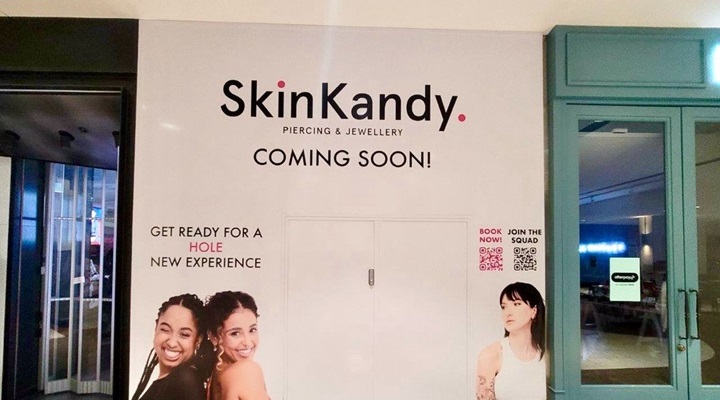
SkinKandy, the largest speciality piercing and jewellery retailer in Australia and New Zealand, has made its debut on the Australian Securities Exchange (ASX) following its Initial Public Offering (IPO). And investors are signalling that they want more.
The 100-store business entered the exchange with a growth plan favoured by investors; it mentioned plans to grow its network to between 180 and 210 stores, adding that it is currently opening between 15 and 20 stores each financial year. This store network is supported by 800 employees, 750 of whom are specially trained piercers.
With $194 million (AU$160 million) raised from the IPO, SkinKandy will now look to expansion beyond its Australian and New Zealand base. “Pursuing agile expansion into priority international markets,” as non-executive chair Trent Peterson put it, is expected to include the UK and US, subject to the board’s review.
First entering New Zealand in 2024 following the opening of two locations, SkinKandy now owns nine sites in the country, a number which thinks could rise to 30 in the future.
It debuted at an opening price of $2.67 per share on the ASX, before rising by 5.9 per cent to $2.83, a sign that demand remained high after its listing.
And for good reason. The now-disclosed financial performance of the business in recent years paints the picture of accelerating revenue and profit growth, with the 2025 financial year bringing $85.1 million and $7.7 million, respectively. SkinKandy added forecasts for fiscal 2026, expecting revenues of $107.8 million and after-tax profits of $10.4 million.
“The industry in ANZ remains highly fragmented, with over 1000 independent salons, beauty operators and pharmacies offering piercing as an ancillary service, presenting a compelling opportunity for a scaled specialist operation with a consistent customer proposition and strong operational standards which are designed to allow SkinKandy to grow share profitably,” Peterson added.
“SkinKandy’s growth has been supported by favourable long-term trends, including demographic shifts which are expanding participation in piercing, and evolving cultural and social norms which are increasing piercing prevalence among both men and women.”