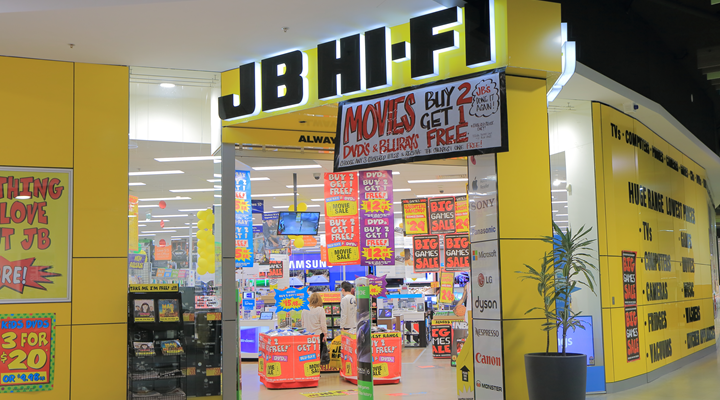
Somewhere between the card terminal and the shopping bag comes a question that electronics shoppers have heard for decades: “Would you like to add an extended warranty today?” For years, it has been a familiar moment in electronics retail, a final upsell offered after the customer has already committed to the purchase. That small question now sits at the centre of a closely watched retail lawsuit in Australia. In late 2023, Maurice Blackburn Lawyers filed a class action in the Supreme Court
rt of Victoria alleging that extended warranties sold by JB Hi-Fi over more than a decade may have provided little or no additional value to consumers. The claim covers warranties purchased between January 1, 2011 and December 8, 2023, a period that spans millions of transactions across one of the country’s most successful retailers, whose Australian sales exceeded $6.5 billion in the most recent financial year.
The legal argument turns on a deceptively simple point within Australian Consumer Law. Consumers are already entitled to what are known as consumer guarantees, which require that products be of acceptable quality and last for a reasonable period of time, given their price and type. If they fail, customers may be entitled to a repair, replacement or refund even after the manufacturer’s warranty expires. According to Maurice Blackburn principal lawyer Miranda Nagy, the class action claims that JB Hi-Fi’s extended warranties often duplicated those rights. “What we’re alleging in the class action is that JB Hi-Fi has been selling extended warranties that essentially offer Australian consumers the same thing as what they already get for free under the Australian Consumer Law.”
Do extra margins add value?
“Extended warranties have been a standard upsell in electronics retail for as long as I can remember,” retail analyst with the Retail Doctor Group Dean Salakas told Inside Retail. “They add extra margins on a product which has thin margins, so it’s an important part of the mix for the retailer, and I don’t think there is any question that they can add value to a customer, but in this case there is a question if it did or not.” In other words, the class action touches not only one retailer’s practices but also a sales model deeply embedded across the category.
In highly competitive categories where consumers often arrive in-store already knowing the exact model they want, retailers consistently rely on post-purchase add-ons to improve margins. Accessories, software packages, interest-riddled finance offers and protection plans are commonly introduced after the customer has committed to the primary purchase. By the time a shopper reaches the checkout, the difficult decision about which product to buy has already been resolved, making it easier for sales staff to introduce additional services without disrupting the original sale.
Salakas noted that ambiguity is precisely where the tension lies. “The consumer already has a strong right based on what would be determined ‘reasonable lifespan’ which nobody really knows what reasonable lifespan is until its tested for example in a case like this,” he said. “This dispute is whether customers were clearly told what their rights were and if they were being sold something that essentially didn’t offer the customer anything other than what they got anyway with their usual rights.”
Consumer group Choice raised similar concerns in 2022 after mystery shopping 80 JB Hi-Fi, Harvey Norman and The Good Guys stores, alleging that 71 per cent of interactions involved sales staff misrepresenting consumer rights while attempting to sell extended warranties, often suggesting coverage ended with the manufacturer’s warranty despite broader protections under Australian Consumer Law.
Simplicity versus legal overtone
Consumers may also be responding to something simpler than legal coverage, as extended warranties offer a clear promise in a space where consumer rights can feel abstract and difficult to interpret in real time. Australian Consumer Law guarantees that products must last a reasonable period, but what constitutes a “reasonable lifespan” is not defined in exact years and often only becomes clear when a dispute is tested.
This raises a broader question about whether Australian Consumer Law itself needs to be communicated more clearly so that consumers understand not only that these rights exist, but how to access and use them when a product fails.
JB Hi-Fi has strongly rejected the allegations and says it will defend the proceedings. In a statement the company said it “takes compliance with its legal obligations very seriously, denies the allegations made in the proceedings and intends to vigorously defend the proceedings.” The trial is scheduled to begin in October and is expected to run for six weeks, a timeline that could place the economics of electronics retail under unusually close legal examination.
Retailers may become far more cautious about how warranties and similar add-on products are presented to customers, with clearer explanations of existing consumer rights required at the point of sale. “It could change how add-on products are sold,” Salakas said. “Force stronger disclosure about consumer rights.”
In the end, the case returns to that familiar moment at the counter, when a customer has already committed to buying a new television or laptop, and the salesperson asks whether they would like a little extra protection. For years, the question has been treated as routine. Now, a courtroom will decide whether it was simply another retail service or a promise that the law had already made.