In 2013, Maku Fenaroli did what most people only daydream about when she first arrived in Melbourne from New Zealand – she painted a wall on AC/DC Lane. “It was the moment that prompted me to start pursuing art seriously,” she told Inside Retail. That impulsive act of self-belief was the catalyst that led her to eventually walk away from her steady corporate job and launch her own wearable-art brand, Maku The Label. From gallery walls to Instagram grids Art was never a hobby for Fena
r Fenaroli so much as a birthright. She grew up in a family of artists in New Zealand, but Melbourne’s laneways and galleries sharpened her focus. That same year, she created an Instagram account to share her paintings and illustrations with a growing online community. “My dream was to quit my job and become an artist,” she recalled, but financial security won out. She took a role at a financial superannuation firm and poured her creative energy into nights and weekends instead.
The work was paying off. By 2015, she had staged her first solo exhibition, and her art appeared on a Melbourne tram, on book covers and in collaborations with brands including Rusty, Dakine and Kollab. Still, the numbers never quite added up to a full-time career. “I began to wonder if I would ever get there,” she said. The dream felt close enough to touch, but not quite sustainable enough to grab.
The $200 T-shirt that changed everything
The turning point came at a moment of near surrender. Standing at a crossroads, Fenaroli was torn between giving up art altogether or returning to university to study fine arts “in the hope of being taken more seriously.” Instead, she chose something braver and far less conventional: she printed her paintings on T-shirts.
The catalyst was deceptively simple. One of her favourite influencer accounts, Smyth Sisters, posted a graphic tee. “She normally only wore basic tees. I wanted one desperately, but it was over $200, and I thought screw it, I’ll make my own. So I did,” she said. Her sister and cousin bought the first tees and became, as she puts it, her “biggest hype queens”. When influencer Sophie Pearce shared the designs a few weeks later, momentum exploded.
Freed from the pressure to be “serious” in a gallery sense, she embraced a looser, more candid approach. “My walls were down. I stopped worrying about what people thought and simply showed up online. It was raw, unpolished and yes, chaotic. But it resonated,” she shared. Four months after that first tee, she resigned from her corporate job—one week before International Women’s Day.
Building a fashion label at the kitchen table
Maku’s first chapter was scrappy by design – printing tees to order allowed the fledgling brand to grow without holding stock or taking on debt. The margins were lean, but the risk was low, and every sale was effectively pre-funded by the customer. “We were never in debt because it was all cash flow in,” she explained.
The flip side was operational chaos. During Maku’s first Boxing Day sale in 2024, demand outstripped capacity. The brand sold out of almost every Comfort Colors tee in Australia, and some customers waited up to three months for their orders. Fenaroli, still working full-time, was up until 11pm most nights manually loading designs onto shirts, fielding customer queries with the help of her mother-in-law and uploading new art to the website the same day she created it. “It was fun, but also just created a lot more work for me,e and there was no real strategy,” she admitted.
Family, though, became both anchor and accelerant. As the label grew, her husband left his role as a plumbing director to join the business – a shift that transformed their daily life with two young children. “To have him home in the mornings to help with the kids for the first time in five years was the most amazing bonus,” she said. The trade-off is intensity: they rarely take a day off, and the social media engine that powers the brand can feel like a 24/7 job.
Ready-to-wear, still rooted in art
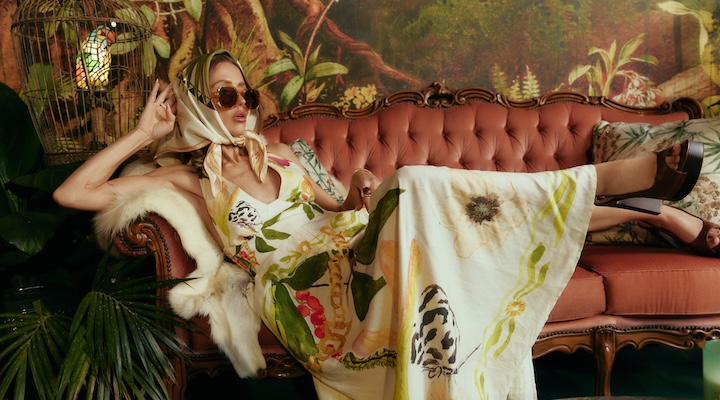
In 2025, Maku took another leap, evolving from made-to-order tees into ready-to-wear collections, beginning with a scarf capsule that sold through key sizes on its first day. Every piece still starts as a painting. “Each piece starts as an artwork, and we will always be that way,” Fenaroli said. She personally paints, scans, lays artwork onto patterns, refines the fit and oversees the final quality check. “It’s a labour of love, and these garments are my babies.”
Scaling up has required new skills and support. A business advisor and range planner have helped her navigate wholesale expectations, cash flow and range building, particularly after the Seaside collection – rich in abstract tailoring and hand-painted pinstripes – proved creatively satisfying but commercially challenging. The lesson, she said, has been “really understanding what the brand is and what we want to look like moving forward.”
Through it all, Maku’s core promise holds: art you can wear, made with family and heart. The tees that started it all remain central, now joined by small-run, art-driven garments that aim to dress “every part” of the Maku customer’s life. As the label scales, Fenaroli is determined to keep the imperfections visible. “We will never be a brand that feels the need to make everything 100 per cent polished,” she said. “We show the behind the scenes… I still reply to every DM and speak to our customers daily, and I think that’s what makes us us.”
Further reading: Inside Uniqlo’s hyper-local collaboration with a cult Melbourne sandwich shop