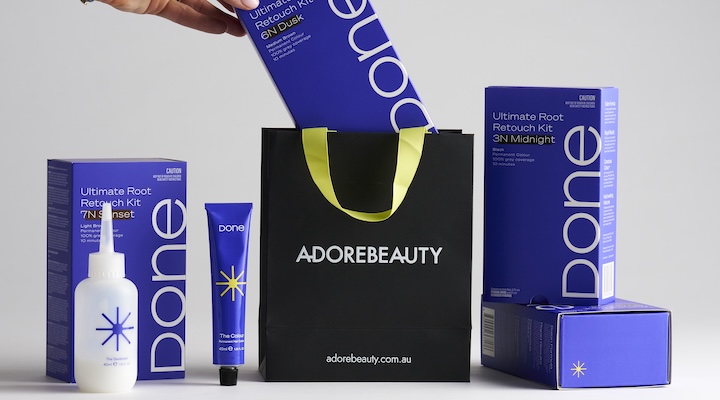
On Thursday, Adore Beauty announced it would stock Done, a new hair colour start-up from Hannah Spilva, the founder of LVLY. The product is a grey root-retouch kit for a forgotten cohort of midlife women expected to drive nearly half of beauty’s value growth over the next decade. In many ways, then, Done is a direct challenge to legacy hair colour models that have treated grey coverage as either a low-margin FMCG play or a salon-bound service. Spilva – who previously built LVLY i
Y into a national same‑day flower delivery business sold for $35 million – is once again zeroing in on an “emotionally loaded ritual” and removing friction.
“The core playbook hasn’t changed: identify an emotionally loaded ritual, remove friction and elevate the experience,” the serial entrepreneur told Inside Retail. At LVLY, that meant forgotten birthdays and last‑minute gifting; at Done, it is the quiet panic of regrowth appearing in the mirror before a meeting or event.
Midlife women move centre stage
Industry data shows consumers aged 45-plus already spend an estimated US$279 billion on beauty annually, a figure forecast to exceed US$430 billion in the coming years. Yet innovation has remained stubbornly youth-focused, leaving midlife shoppers to navigate a binary choice: low-cost supermarket box dye or hours in a salon chair. “The management of grey regrowth is one of the most relentless burdens of beauty,” stated Spilva. “Greys reappear like clockwork on a three to six week cycle, and we’re often covering them for decades before feeling ready to embrace the transition.” When she stepped back and looked at the space, she realised the category opportunity was “obvious.”
Redefining grey maintenance
Done’s answer is the Ultimate Root Retouch Kit, a 10‑minute at-home system promising 100 per cent grey coverage and up to six weeks of seamless root management. Powered by the brand’s “Conscious Colour” formula, it sits deliberately between box dye and the salon, using a permanent, salon-grade colour free from ammonia, PPD, resorcinol, phthalates and parabens. Spilva set three non‑negotiables for the launch: performance (“it had to deliver 100 per cent grey coverage in 10 minutes”), formula integrity, and an elevated experience that extended beyond a basic colour-and-developer bottle. Each kit includes barrier cream, hydrating shampoo, nourishing conditioner and a gloss treatment, with the goal of making an often-messy chore feel like a considered ritual.
Frequency, emotion and lifetime value
For retailers, the appeal is structural as much as emotional. Grey maintenance combines “frequency, emotion and longevity in a way very few beauty categories do,” Spilva argued. Regrowth returns every three to six weeks, often for decades, creating a predictable, repeat-driven cycle that lends itself to subscription and high lifetime value. Done has built its business model around that cadence, focusing not on dramatic colour transformations but on maintenance as a long-term ritual. “We’re not trying to be a full-spectrum colour brand. We’re solving one high-frequency problem exceptionally well,” she said. Early data from the brand’s personalised subscription service shows a median repeat purchase cycle “much faster than most other beauty categories”, with customers able to “set, forget and receive their colour kits exactly when they need them.”
Why Adore’s bet matters
Adore Beauty’s early embrace of a months-old brand reflects how seriously major retailers are now taking the 40-plus segment. The company described Done’s target as “busy humans with high expectations” who want convenience “but never at the expense of quality” – a profile that closely mirrors Adore’s own core customer. “Done has a compelling point of difference and a strong founder vision,” Kristy Shea, Adore Beauty’s senior merchandise manager for haircare and fragrance, told Inside Retail. “The brand solves a real gap in the market, and in our range, that our customers are looking for.” According to Spilva, the retailer was convinced by the clarity of Done’s positioning and the fact that its team “road-tested the products and quickly became genuine customers themselves – which says more than any pitch deck ever could.” They also recognised the “structural gap” between low-cost box dye and the salon chair, and the opportunity to define a credible premium maintenance category in the middle.
Convenience as the new luxury
Crucially, Done reframes convenience not as a race to the bottom, but as a new form of luxury. “For our customer, time is the ultimate luxury,” Spilva said. The promise of 10‑minute roots is less about speed for its own sake than about “hours not spent in a salon chair, calendar space freed up, a sense of control over your routine, less mental load.” That calculus aligns with broader shifts in prestige beauty, where value is increasingly measured in time saved, mental bandwidth reduced and confidence gained, rather than in purely aspirational imagery. The brand’s “No Grey Days” tagline is doing double duty: it speaks to both reliable coverage and the emotional payoff of feeling like oneself.
For an industry still heavily anchored to youth campaigns and one‑off trends, Adore Beauty’s Done launch underscores a reordering of priorities. As consumers in their forties, fifties and beyond become the engine of growth, the brands that win will be those that treat their realities – greys, hormonal shifts, density changes, maintenance cycles – as design constraints rather than afterthoughts. Done’s tightly focused offer, subscription-led model and insistence on “convenience without compromise” suggest an emerging blueprint: solve a recurring, emotionally charged problem; respect midlife consumers’ time and intelligence; and build loyalty not around novelty, but around confidence.
Furhter reading: Why Australia’s Adore Beauty gave its loyalty program an extreme makeover